


In recent days, we have been witnessing what one might call an Odysseiad: the commentary on Nolan’s latest film, The Odyssey, by anyone with an opinion, whether before seeing it in cinemas or — perhaps more fairly — afterwards. As with another film that caused a stir in Greece a few months ago, the one about the life and death of Ioannis Kapodistrias, the first and last Governor of Greece, I had decided to let the noise die down a little before watching The Odyssey myself. There was never any chance that I would not see it, whatever the reactions might be, because I love Nolan and his work. That is why I have already booked tickets for tomorrow.
(you’ll find the original text in Greek below)
One might say that, in that case, it would have been better to write this stack after seeing the film. But this stack, fellow historiophile, is not yet another commentary on the movie, its inaccuracies, or its cinematic grandeur. I am not worried about the Homeric epics, nor about the way Hollywood has treated my homeland’s mythology over the years. The Homeric epics have been around for more than 2,500 years, and they have been taught continuously in Greek schools for generations, whatever power may have held sway in the Greek world. Their enduring presence lies in the fact that every age receives the epics, the great classical plays, and classical literature in general differently, according to its own needs. This means that any creator of a modern adaptation is free to reshape them into a version we may not personally like; so what each of us thinks about such variations probably matters very little. As the Romans used to say, de gustibus non est disputandum — or, in English, there’s no accounting for taste. We may not like it, but this is precisely how such works remain popular and relevant, thousands of years after they were first created.
(For now, this essay is available for everyone to read. If you’d like unlimited access to the full archive and want to support the work behind this newsletter, consider becoming a paid subscriber.)
But I digress, for our subject is something else. Those who have been here on this Substack for a while will already know my love not only for history and archaeology, but also for poetry. I have already published quite a few stacks in which I try, through poetry, either to express my feelings, or to make sense of current events, or — my personal favourite — to describe historical events and periods. Some of you may also have noticed my preference for C. P. Cavafy, the poet-historian, as he liked to call himself. Members of the Historiophiles Society, have even received a printout of perhaps my favourite poem, Cavafy’s “Thermopylae.”
The whole discussion around Nolan’s Odyssey, however, reminded me of two poems I love: another poem by C.P. Cavafy, perhaps his best-known one, which we mentioned briefly last year, “Ithaka,” and “Upon a Line of Foreign Verse” by the Nobel laureate in Literature (1963), George Seferis, whose relationship with Cavafy we also touched on briefly last year.
While Homer describes Odysseus as ‘δαΐφρων’ (battle-minded, wise-hearted, fiery-hearted), ‘τάλα’ (wretched, pitiable), ‘τλήμων’ (enduring, stout-hearted, long-suffering), and πολύτροπο (resourceful, complicated, a man of twists and turns — perhaps the most frequently debated of Odysseus’ epithets), among others, Seferis in his poem borrows the first line, “Heureux qui, comme Ulysse, a fait un beau voyage…”, from a 16th-century sonnet by Joachim du Bellay, literally standing “on a foreign verse,” in order to create a rather different Odysseus:
(to Elli, Christmas 1931)
Happy is he who has made the journey of Odysseus. Happy if,
as the journey loomed,
he felt the sturdy rigging of a love, stretched taut inside his body like
the veins where the blood boomed.
Of a love with unbroken rhythm, invincible as music and undying,
because it was born when we were born, and whether it dies when we do,
we do not know, and it is no use trying.
God help me to say, in a moment of great joy, what is this love?
I sit sometimes surrounded by an alien land, and I hear its distant
roar, like the boom of the sea mingled with an inexplicable
whirlwind from above.
And again and again, the shade of Odysseus appears before me, with
eyes red from the brine of the waves, and from a ripe yearning to
see once more
the smoke wafting from the warmth of his house, and the dog grown
old waiting at the door.
There he stands, tall, whispering through his whitened beard words
of our tongue, as it was spoken three thousand years ago.
He holds out a palm calloused from the ropes and the tiller, with skin
weathered by the dry north wind, by the scorching heat and the snow.
It’s as though he wants to banish from our midst the superhuman
Cyclops, who watches with one eye, the Sirens, whose song makes
you forget, and Scylla and Charybdis, who swallow you whole,
so many elaborate monsters that keep us from reflecting how he was a
man who strove in the world, with his body and his soul.
He is the great Odysseus, the one who directed them to build the
wooden horse, and the Achaeans won Troy;
I imagine he is coming to tell me how to build a wooden horse
so I may win my own Troy.
Because he speaks humbly and serenely, without effort,
he seems to know me like a father, or like the old mariners, who,
leaning on their nets, at the hour of winter and the wind’s anger,
would sing to me in my childhood the song of Erotokritos, with their eyes full of tears,
and in my sleep, still thinking of the unjust fate of Arete descending the marble staircase, I was seized with fears.
He tells me how hard the pain is, to feel the sails of your ship belly with memory and your soul become the helm,
to be alone and rudderless as chaff on the threshing floor, when the shadows overwhelm,
the bitterness of seeing your companions sunk into the elements, scattered, one by one,
and how strange it is to become a man by speaking with the Dead, when the Living who remain are no longer sufficient unto you—none.
He speaks . . . I still see his hands, that knew how to test if the mermaid on the prow was well-carven, without splinter,
giving me the unruffled blue sea in the heart of winter.
Excerpted from THIS AFTERLIFE: Selected Poems.
Published by Farrar, Straus and Giroux.
Copyright © 2022 by A. E. Stallings.
All rights reserved. [poems.com]
For Homer, Odysseus is the long-suffering, patient, and experienced traveller — the man who refuses Calypso’s offer of immortality and instead relies on his mind to survive in an epic world so that he may return to his kingdom. For Du Bellay, in the Renaissance revival of the classical ideal, Odysseus’ journey was beautiful (beau voyage) because it ended happily: the hero came home, grew old in peace among his own people, and reaped the rewards of his labours.
Seferis on the other hand, strips Odysseus of his heroic, epic aura and reshapes him into a universal symbol of the modern exile and sufferer. The Seferic hero is not concerned with nostos or a triumphant return to his palace; instead, he appears as a weary ghost of memory. Marked by the experience of the Asia Minor Catastrophe and exile, the poet turns him into the archetype of the hunted man in search of a homeland, knowing that the journey also contains loss and an unhealed ache. And when it is over, he shares the knowledge he has gathered not as a dazzling achievement, but as an old, tired secret of survival.
(Not ready to upgrade yet? You can still support the effort behind this newsletter for free by simply tapping the like button or restacking this post. Alternatively, you can always treat me to a frappé coffee:)
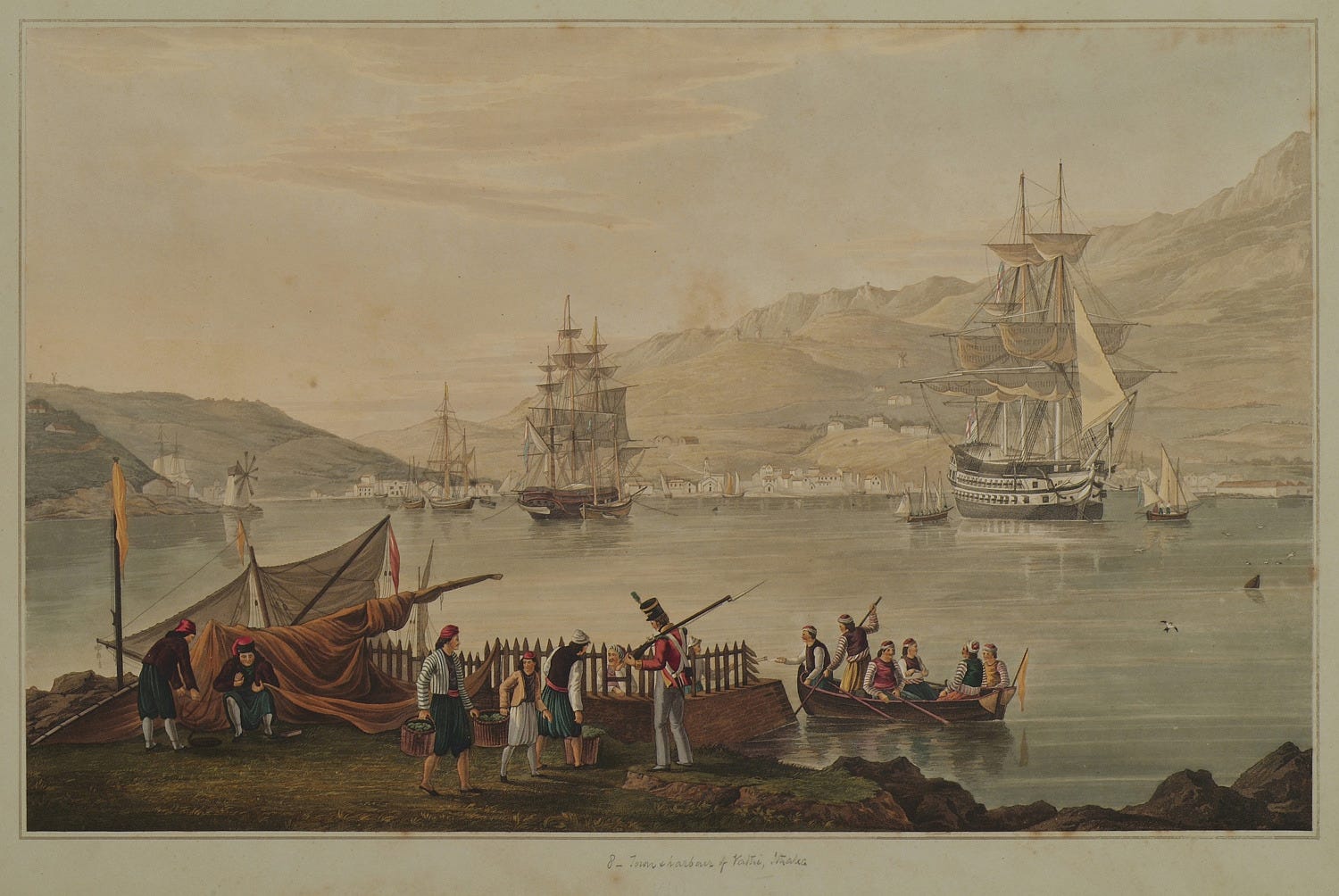
But what, after all, is Odysseus’ homeland? It is none other than the longed-for Ithaca — the “rugged, yet good nurse of lads” («τρηχεῖ’, ἀλλ’ ἀγαθὴ κουροτρόφος») and eudeielos («εὐδείελος»-sunlit, clearly visible) Ithaca, as Homer calls it. This small, rocky and verdant island in the Ionian Sea is what makes Odysseus reject Calypso’s immortality, just so he can see the smoke rising from the hearths of its houses. It is the end, the ultimate goal of nostos.
It is Cavafy’s poor Ithaca. Not poor in the sense of barren, but stripped of all unnecessary adornment and of the illusion of a final, tangible — and ultimately insignificant — reward:
As you set out for Ithaka
hope the voyage is a long one,
full of adventure, full of discovery.
Laistrygonians and Cyclops,
angry Poseidon—don’t be afraid of them:
you’ll never find things like that on your way
as long as you keep your thoughts raised high,
as long as a rare excitement
stirs your spirit and your body.
Laistrygonians and Cyclops,
wild Poseidon—you won’t encounter them
unless you bring them along inside your soul,
unless your soul sets them up in front of you.
Hope the voyage is a long one.
May there be many a summer morning when,
with what pleasure, what joy,
you come into harbors seen for the first time;
may you stop at Phoenician trading stations
to buy fine things,
mother of pearl and coral, amber and ebony,
sensual perfume of every kind—
as many sensual perfumes as you can;
and may you visit many Egyptian cities
to gather stores of knowledge from their scholars.
Keep Ithaka always in your mind.
Arriving there is what you are destined for.
But do not hurry the journey at all.
Better if it lasts for years,
so you are old by the time you reach the island,
wealthy with all you have gained on the way,
not expecting Ithaka to make you rich.
Ithaka gave you the marvelous journey.
Without her you would not have set out.
She has nothing left to give you now.
And if you find her poor, Ithaka won’t have fooled you.
Wise as you will have become, so full of experience,
you will have understood by then what these Ithakas mean.
Reprinted from C.P. CAVAFY: Collected Poems Revised Edition, translated by Edmund Keeley and Philip Sherrard, edited by George Savidis. Translation copyright © 1975, 1992 by Edmund Keeley and Philip Sherrard. Princeton University Press. [Onassis.org]
Louis de Bernières, the bestselling novelist who became famous with Captain Corelli’s Mandolin, summed up Cavafy’s “Ithaka” with a touch of exaggeration about the abilities of Greek schoolchildren:
“For example, there is not a schoolchild in Greece who does not know ‘Ithaka’ by heart. There Cavafy says that what matters is not reaching the destination: it is acquiring, through the journey, the richest possible experience. That is how I feel about life too.”
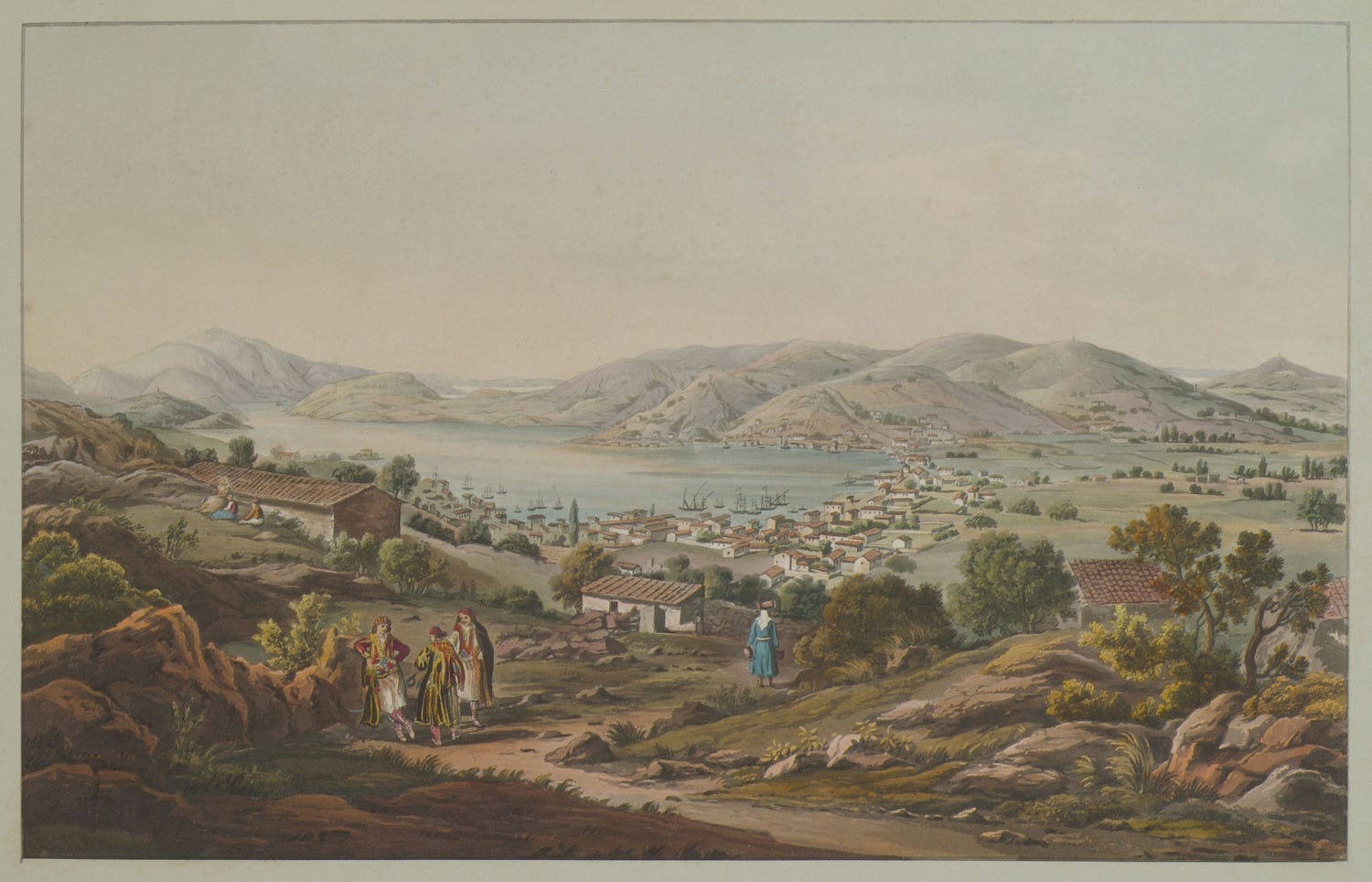
So is “Ithaka,” then, an epitome of practical wisdom? Is it really a didactic poem, one that teaches us how to enjoy the journey of life by gathering experience, adventure, and knowledge along the way? Though many dismiss the poem’s didacticism as too obvious, and look in it for something beyond the familiar “live each day as if it were your last” or “the journey matters more than the destination,” Cavafy himself seems to have encouraged precisely such a life-wisdom reading, when he commented on “Ithaka” to G. Lechonitis:
“The meaning of this poem is simple and clear. A man in life, pursuing a goal (Ithaca), acquires experience, knowledge, and sometimes goods superior to the goal itself.”
Some, including Seferis himself, and G. P. Savidis — perhaps the most important Cavafy scholar, editor, and publisher in Greece — see in “Ithaka” something beyond commonplace wisdom: a commentary by the poet on his own poetic journey and development.
This is, after all, the role of poetry: not to be exhausted by a single reading, but to remain open to different interpretations, revealing something new to each reader in turn.
And one interesting side note: it was the English writer E. M. Forster who first brought Cavafy decisively to the attention of the English-speaking world, with the indirect contribution and poetic influence of T. S. Eliot, and with the help of G. Seferis.
It would still take several decades, however, before Cavafy became widely known on the other side of the Atlantic. After Maurice Tempelsman, Jacqueline Kennedy Onassis’s last companion, read “Ithaka” at her funeral in May 1994 — perhaps as a reflection on her life, and perhaps also to evoke the years she had spent in Greece at Aristotle Onassis’s side — the poem was republished in the New York Times in the now classic English translation by Edmund Keeley and Philip Sherrard, first published in 1975. In the days that followed, demand for the translation surged, prompting Princeton University Press to reprint the volume. Within just twenty days, nearly twice as many copies were sold as had been sold in the previous twenty years.
In fact, Tempelsman thought it was a good idea to add some syrupy verses of his own invention at the end of the poem: “And now the journey is over, too short, alas too short. / It was filled with adventure and wisdom, laughter and love, gallantry and grace. / So farewell, farewell.”
However one imagines Ithaca, Odysseus, and the other protagonists of the Homeric epics, one thing is certain: they will remain with us long after we are gone, always receiving fresh form and meaning from each of us.
That, after all, is the definition of classic: what lives beyond its own age, withstands different interpretations, and keeps returning anew in every generation, while preserving its enduring value through time.
Bonus video: Sir Sean Connery recites the poem Ithaca. I literally felt goosepumps the first time I heard him riciting this. To be honest, I still do:
(An important source, among others, on Cavafy’s “Ithaka,” was Vayos Liapis’s article on hartismag.gr.)
For now, this essay is available for everyone to read. If you value this kind of authentic deep dives and want to support my work in bringing history, archaeology, and culture to life, consider becoming a paid subscriber.
Not ready to upgrade? You can still support the immense effort behind this newsletter for free by simply tapping the like button or restacking this post. Alternatively, you can always treat me to a frappé coffee:
Until the next stack, ἔρρωσθε καὶ εὐδαιμονεῖτε.
(παρακάτω θα βρείτε το κείμενο στα ελληνικά)
Το τελευταίο διάστημα παρατηρούμε να λαμβάνει χώρα η Οδυσσειάδα: ο σχολιασμός της τελευταίας ταινίας του Νόλαν Οδύσσεια από σχετικούς και άσχετους, είτε πριν τη δει κάποιος στους κινηματογράφους, είτε -μάλλον το πιο δίκαιο- μετά. Όπως και με μία άλλη ταινία που δημιούργησε μεγάλο θόρυβο στην Ελλάδα πριν λίγους μήνες, αυτή που πραγματεύονταν τη ζωή και το θάνατο του πρώτου και τελευταίου Κυβερνήτη της Ελλάδας, Ιωάννη Καποδίστρια, περίμενα να καταλαγιάσει λίγο ο θόρυβος για να δω και την Οδύσσεια. Δεν υπήρχε περίπτωση να μην τη δω, παρά τις όποιες αντιδράσεις, γιατί λατρεύω τον Νόλαν και τη δουλειά του. γι’ αυτό και έχω κλείσει εισιτήρια για αύριο.
Θα πει κανείς, ίσως θα ήταν τότε καλύτερο να γράψω αυτό εδώ το stack αφού δω την ταινία, αλλά το παρόν stack, αγαπητέ historiophile, δεν αποτελεί άλλον έναν σχολιασμό της ταινίας, των όποιων ανακριβειών της ή του κινηματογραφικού της μεγαλείου. Δεν ανησυχώ για τα ομηρικά έπη, ούτε για το πώς μεταχειρίζεται διαχρονικά το Hollywood τη μυθολογία της πατρίδας μου. Τα ομηρικά έπη υπάρχουν εδώ και περισσότερα από 2.500 χρόνια και διδάσκονται αδιαλείπτως στα ελληνικά σχολεία, ανεξάρτητα από το ποια ήταν η κυρίαρχη δύναμη στον ελλαδικό χώρο. Αυτή η διαχρονικότητά τους, έγκειται στο γεγονός ότι η κάθε εποχή προσλαμβάνει τα έπη, τα κλασικά θεατρικά έργα και γενικά την κλασική λογοτεχνία, διαφορετικά και ανάλογα με τις ανάγκες της. Αυτό σημαίνει ότι μπορεί ο κάθε δημιουργός μιας σύγχρονης απόδοσής τους να τα παραλλάξει, σε μια εκδοχή τους που να μην μας αρέσει προσωπικά, οπότε μάλλον δεν έχει πολύ σημασία τι λέει ο καθένας μας για τις όποιες παραλλαγές. Όπως έλεγαν και οι Ρωμαίοι, de gustibus non est disputandum ή στα ελληνικά περί ορέξεως κολοκυθόπιτα ή στα αγγλικά there’s no accounting for taste. Μπορεί σε εμάς να μην αρέσει δηλαδή, αλλά έτσι καταφέρνουν να παραμένουν δημοφιλή και επίκαιρα, χιλιάδες χρόνια μετά τη δημιουργία τους.
Αλλά παρέκκλινα, καθώς το θέμα μας είναι άλλο. Οι πιο παλιοί σε αυτό εδώ το Substack, θα έχουν αντιληφθεί την αγάπη μου όχι μόνο για την ιστορία και την αρχαιολογία, αλλά και για την ποίηση. Έχουν προηγηθεί αρκετά stacks, στα οποία προσπαθώ μέσω της ποίησης είτε να εκφράσω τα συναισθήματά μου, είτε να δώσω μία εξήγηση στην επικαιρότητα, είτε - το πιο αγαπημένο μου - να περιγράψω ιστορικά γεγονότα και περιόδους. Ίσως μάλιστα έχετε αντιληφθεί κάποιοι την προτίμησή μου στο Κ.Π. Καβάφη, τον ποιητή - ιστορικό, όπως αρέσκονταν και ο ίδιος να αποκαλεί τον εαυτό του. Τα μέλη της Historiophiles Society δε, έχουν λάβει μία εκτύπωση με το αγαπημένο μου ίσως ποίημα, το «Θερμοπύλες» του Καβάφη.
Η όλη συζήτηση πάνω στην Οδύσσεια του Νόλαν, όμως, μου θύμισε δύο αγαπημένα μου ποιήματα: ένα ακόμη ποίημα του Καβάφη, το πιο γνωστό του ίσως, το οποίο είχαμε αναφέρει επιγραμματικά πέρυσι, την «Ιθάκη» και το «Πάνω σ’ έναν ξένο στίχο» του τιμημένου με Νόμπελ Λογοτεχνίας (1963), Γιώργου Σεφέρη, για τη σχέση του οποίου με τον Καβάφη αναφερθήκαμε επίσης επιγραμματικά πέρυσι.
Ενώ λοιπόν ο Όμηρος χαρακτηρίζει τον Οδυσσέα ‘δαΐφρων’ (εμπειροπόλεμο-wise-hearted, fiery-hearted ή πιο κυριολεκτικά battle-minded), ‘τάλα’ (ταλαίπωρο-wretched, pitiable), ‘τλήμων’ (καρτερικός-enduring, stout-hearted, long-suffering) και πολύτροπο (resourceful, complicated, man of twists and turns–ο πιο πολυσυζητημένος χαρακτηρισμός ίσως του Οδυσσέα), μεταξύ άλλων, ο Σεφέρης στο ποίημά του δανείζεται τον πρώτο στίχο “Heureux qui, comme Ulysse, a fait un beau voyage…” από ένα σονέτο του 16ου αιώνα του Joachim du Bellay, “πατώντας” κυριολεκτικά «πάνω σ’ έναν ξένο στίχο», για να φτιάξει έναν λίγο διαφορετικό Οδυσσέα:
(Στην Έλλη, Χριστούγεννα 1931)
Ευτυχισμένος που έκανε το ταξίδι του Οδυσσέα.1
Ευτυχισμένος αν στο ξεκίνημα, ένιωθε γερή την αρματωσιά μιας αγάπης, απλωμένη μέσα στο κορμί του, σαν τις φλέβες όπου βουίζει το αίμα.
Μιας αγάπης με ακατέλυτο ρυθμό, ακατανίκητης σαν τη μουσική και παντοτινής
γιατί γεννήθηκε όταν γεννηθήκαμε και σαν πεθαίνουμε, αν πεθαίνει, δεν το ξέρουμε ούτε εμείς ούτε άλλος κανείς.
Παρακαλώ το θεό να με συντρέξει να πω, σε μια στιγμή μεγάλης ευδαιμονίας, ποιά είναι αυτή η αγάπη·
κάθομαι κάποτε τριγυρισμένος από την ξενιτιά, κι ακούω το μακρινό βούισμά της, σαν τον αχό της θάλασσας που έσμιξε με το ανεξήγητο δρολάπι.
Και παρουσιάζεται μπροστά μου, πάλι και πάλι, το φάντασμα του Οδυσσέα, με μάτια κοκκινισμένα από του κυμάτου την αρμύρα
κι από το μεστωμένο πόθο να ξαναδεί τον καπνό που βγαίνει από τη ζεστασιά του σπιτιού του και το σκυλί του που γέρασε προσμένοντας στη θύρα.
Στέκεται μεγάλος, ψιθυρίζοντας ανάμεσα στ’ ασπρισμένα του γένια, λόγια της γλώσσας μας, όπως τη μιλούσαν πριν τρεις χιλιάδες χρόνια.
Απλώνει μια παλάμη ροζιασμένη από τα σκοινιά και το δοιάκι, με δέρμα δουλεμένο από το ξεροβόρι από την κάψα κι από τα χιόνια.
Θα ’λεγες πως θέλει να διώξει τον υπεράνθρωπο Κύκλωπα που βλέπει μ’ ένα μάτι, τις Σειρήνες που σαν τις ακούσεις ξεχνάς, τη Σκύλλα και τη Χάρυβδη απ’ ανάμεσό μας·
τόσα περίπλοκα τέρατα, που δε μας αφήνουν να στοχαστούμε πως ήταν κι αυτός ένας άνθρωπος που πάλεψε μέσα στον κόσμο, με την ψυχή και με το σώμα.
Είναι ο μεγάλος Οδυσσέας· εκείνος που είπε να γίνει το ξύλινο άλογο και οι Αχαιοί κερδίσανε την Τροία.
Φαντάζομαι πως έρχεται να μ’ αρμηνέψει πώς να φτιάξω κι εγώ ένα ξύλινο άλογο για να κερδίσω τη δική μου Τροία.
Γιατί μιλά ταπεινά και με γαλήνη, χωρίς προσπάθεια, λες με γνωρίζει σαν πατέρας
είτε σαν κάτι γέρους θαλασσινούς, που ακουμπισμένοι στα δίχτυα τους, την ώρα που χειμώνιαζε και θύμωνε ο αγέρας,
μου λέγανε, στα παιδικά μου χρόνια, το τραγούδι του Ερωτόκριτου, με τα δάκρυα στα μάτια·
τότες που τρόμαζα μέσα στον ύπνο μου ακούγοντας την αντίδικη μοίρα της Αρετής να κατεβαίνει τα μαρμαρένια σκαλοπάτια.
Μου λέει το δύσκολο πόνο να νιώθεις τα πανιά του καραβιού σου φουσκωμένα από τη θύμηση και την ψυχή σου να γίνεται τιμόνι.
Και να ’σαι μόνος, σκοτεινός μέσα στη νύχτα και ακυβέρνητος σαν τ’ άχερο στ’ αλώνι.
Την πίκρα να βλέπεις τους συντρόφους σου καταποντισμένους μέσα στα στοιχεία, σκορπισμένους: έναν έναν.
Και πόσο παράξενα αντρειεύεσαι μιλώντας με τους πεθαμένους, όταν δε φτάνουν πια οι ζωντανοί που σου απομέναν.
Μιλά… βλέπω ακόμη τα χέρια του που ξέραν να δοκιμάσουν αν ήταν καλά σκαλισμένη στην πλώρη η γοργόνα
να μου χαρίζουν την ακύμαντη γαλάζια θάλασσα μέσα στην καρδιά του χειμώνα.
Γιώργος Σεφέρης. 1940. Τετράδιο Γυμνασμάτων, Α΄ (1928-1937). Αθήνα: τυπ. Ταρουσόπουλου. Και στον συγκεντρωτικό τόμο: Γιώργος Σεφέρης. [1972] 1985. Ποιήματα. 15η έκδ. Αθήνα: Ίκαρος. [greek-language.gr]
Για τον Όμηρο, ο πολύπαθος, καρτερικός και πολύπειρος άνθρωπος-ταξιδευτής, αυτός που αρνείται την αθανασία από την Καλυψώ, χρησιμοποιεί το μυαλό του για να επιβιώσει μέσα σε έναν επικό κόσμο, ώστε να επιστρέψει στο βασίλειό του. Για τον Du Bellay της Αναγέννησης του κλασικού ιδεώδους, το ταξίδι του Οδυσσέα ήταν «ωραίο» (beau voyage) γιατί είχε ευτυχισμένο τέλος: ο ήρωας γύρισε πίσω, γέρασε ήρεμος ανάμεσα στους δικούς του και απόλαυσε τους καρπούς των κόπων του.
Ο Σεφέρης από την άλλη, απογυμνώνει τον Οδυσσέα από την ηρωική, επική του αίγλη και τον μεταπλάθει σε ένα οικουμενικό σύμβολο του σύγχρονου, εξόριστου και ταλαιπωρημένου ανθρώπου. Ο σεφερικός ήρωας δεν εστιάζει στο νόστο και τη θριαμβευτική επιστροφή στο παλάτι του, αλλά εμφανίζεται ως ένα κουρασμένο φάντασμα της μνήμης. Kουβαλώντας τα βιώματα της Μικρασιατικής Καταστροφής και της εξορίας, ο ποιητής τον μετατρέπει στο αρχέτυπο του κυνηγημένου ανθρώπου που αναζητά μια πατρίδα, γνωρίζοντας ότι το ταξίδι περιέχει απώλεια και αθεράπευτο καημό. Και όταν αυτό τελειώνει, μοιράζεται τη συσσωρευμένη γνώση του όχι ως λαμπρό κατόρθωμα, αλλά σαν ένα παλιό, κουρασμένο μυστικό επιβίωσης.
Ποια είναι η πατρίδα του Οδυσσέα όμως; Αυτή, δεν είναι άλλη από την πολυπόθητη Ιθάκη. Η «τρηχεῖ’, ἀλλ’ ἀγαθὴ κουροτρόφος» (τραχιά, μα καλή τροφός παλικαριών) και εὐδείελος (ηλιόλουστη/ευδιάκριτη) κατά τον Όμηρο Ιθάκη. Το μικρό, πετρώδες νησί του Ιονίου Πελάγους για το οποίο ο Οδυσσέας αρνείται την αθανασία της Καλυψώς, μόνο και μόνο για να δει τον καπνό να βγαίνει από τα τζάκια των σπιτιών της. Είναι το τέλος, ο απόλυτος σκοπός του νόστου.
Η πτωχική, κατά τον Καβάφη, Ιθάκη. Όχι όμως υπό την έννοια της μη εύφορης, αλλά της απαλλαγμένης από τα περιττά στολίδια και την ψευδαίσθηση της τελικής, χειροπιαστής –και ασήμαντης τελικά– ανταμοιβής:
Σα βγεις στον πηγαιμό για την Ιθάκη,
να εύχεσαι νάναι μακρύς ο δρόμος,
γεμάτος περιπέτειες, γεμάτος γνώσεις.
Τους Λαιστρυγόνας και τους Κύκλωπας,
τον θυμωμένο Ποσειδώνα μη φοβάσαι,
τέτοια στον δρόμο σου ποτέ σου δεν θα βρεις,
αν μέν’ η σκέψις σου υψηλή, αν εκλεκτή
συγκίνησις το πνεύμα και το σώμα σου αγγίζει.
Τους Λαιστρυγόνας και τους Κύκλωπας,
τον άγριο Ποσειδώνα δεν θα συναντήσεις,
αν δεν τους κουβανείς μες στην ψυχή σου,
αν η ψυχή σου δεν τους στήνει εμπρός σου.
Να εύχεσαι νάναι μακρύς ο δρόμος.
Πολλά τα καλοκαιρινά πρωιά να είναι
που με τι ευχαρίστησι, με τι χαρά
θα μπαίνεις σε λιμένας πρωτοειδωμένους·
να σταματήσεις σ’ εμπορεία Φοινικικά,
και τες καλές πραγμάτειες ν’ αποκτήσεις,
σεντέφια και κοράλλια, κεχριμπάρια κ’ έβενους,
και ηδονικά μυρωδικά κάθε λογής,
όσο μπορείς πιο άφθονα ηδονικά μυρωδικά·
σε πόλεις Aιγυπτιακές πολλές να πας,
να μάθεις και να μάθεις απ’ τους σπουδασμένους.
Πάντα στον νου σου νάχεις την Ιθάκη.
Το φθάσιμον εκεί είν’ ο προορισμός σου.
Aλλά μη βιάζεις το ταξείδι διόλου.
Καλλίτερα χρόνια πολλά να διαρκέσει·
και γέρος πια ν’ αράξεις στο νησί,
πλούσιος με όσα κέρδισες στον δρόμο,
μη προσδοκώντας πλούτη να σε δώσει η Ιθάκη.
Η Ιθάκη σ’ έδωσε τ’ ωραίο ταξείδι.
Χωρίς αυτήν δεν θάβγαινες στον δρόμο.
Άλλα δεν έχει να σε δώσει πια.
Κι αν πτωχική την βρεις, η Ιθάκη δεν σε γέλασε.
Έτσι σοφός που έγινες, με τόση πείρα,
ήδη θα το κατάλαβες η Ιθάκες τι σημαίνουν.
Επιμέλεια Γ. Π. Σαββίδη. Τα Ποιήματα, Τ. Α’ 1897 - 1918, Ίκαρος 1963 [onassis.org]
Ο Louis de Bernières, ο ευπώλητος πεζογράφος που έγινε διάσημος με «Το Μαντολίνο του Λοχαγού Κορέλι», συνόψισε για την Ιθάκη του Καβάφη, με μια δόση υπερβολής για τις ικανότητες των Ελλήνων μαθητών:
«Την Ιθάκη, για παράδειγμα, δεν υπάρχει μαθητής στην Ελλάδα που να μην την ξέρει απέξω. Εκεί ο Καβάφης λέει πως αυτό που μετράει δεν είναι το φτάσιμο: είναι το ν’ αποκτήσεις από το ταξίδι όσο μπορείς πιο πλούσιες εμπειρίες. Έτσι λοιπόν νιώθω κι εγώ για τη ζωή.»
Είναι, λοιπόν, η «Ιθάκη» μια επιτομή πρακτικής βιοσοφίας; Πρόκειται όντως για ένα διδακτικό ποίημα που μας μαθαίνει πώς να απολαμβάνουμε το ταξίδι της ζωής, αντλώντας καθημερινά εμπειρίες, περιπέτειες και γνώση; Αν και πολλοί κατηγορούν τον διδακτισμό της «Ιθάκης» ότι παραείναι προφανής, και αναζητούν σε αυτή κάτι παραπάνω από το «ζήσε κάθε μέρα σαν να είναι η τελευταία σου» ή «το ταξίδι μετρά περισσότερο από τον προορισμό», ο ίδιος ο Καβάφης φέρεται να ενθάρρυνε μια τέτοια βιοσοφική ερμηνεία, σχολιάζοντας την «Ιθάκη» στον Γ. Λεχωνίτη:
«Το νόημα του ποιήματος τούτου είναι απλούν και σαφές. Ο άνθρωπος εις την ζωήν του επιδιώκων ένα σκοπόν (την Ιθάκην) αποκτά πείραν, γνώσεις και ενίοτε αγαθά ανώτερα του σκοπού αυτού καθ’ εαυτού.»
Κάποιοι, μεταξύ τον οποίων ο ίδιος ο Σεφέρης, αλλά και ο Γ. Π. Σαββίδης, ίσως ο πιο σημαντικός μελετητής, επιμελητής και εκδότης του Καβάφη στην Ελλάδα, βλέπουν στην «Ιθάκη» πέρα από την τετριμμένη θυμοσοφία, ένα σχόλιο του ποιητή πάνω στην ποιητική του πορεία και εξέλιξη.
Αυτός είναι τελικά ο ρόλος της ποίησης: να μην εξαντλείται σε μία μόνο ερμηνεία, αλλά να μένει ανοιχτή σε διαφορετικές αναγνώσεις, φωτίζοντας κάθε φορά κάτι νέο στον αναγνώστη.
Και ένα ενδιαφέρον παραλειπόμενο: Ήταν ο Άγγλος συγγραφέας E. M. Forster που ανέδειξε καθοριστικά τον Καβάφη στο αγγλόφωνο κοινό, με την έμμεση συμβολή και την ποιητική επιρροή του T.S. Eliot και τη συνδρομή του Γ. Σεφέρη.
Έπρεπε να περάσουν μερικές δεκαετίες όμως, για να γίνει ο Καβάφης ευρύτερα γνωστός και στην άλλη πλευρά του Ατλαντικού. Όταν ο Maurice Tempelsman, τελευταίος σύντροφος της Jacqueline Kennedy Onassis, γνωστή και ως Τζάκι Ω, διάβασε στην κηδεία της τον Μάιο του 1994 την «Ιθάκη», ως απολογισμό ίσως του βίου της, και για να ξαναζωντανέψει ακόμα τα χρόνια της στην Ελλάδα, στο πλευρό του Αριστοτέλη Ωνάση, το ποίημα αναδημοσιεύτηκε στους Τάιμς της Νέας Υόρκης, στην κλασική πια αγγλική μετάφραση του Edmund Keeley και του Philip Sherrard, που είχε πρωτοεκδοθεί το 1975. Τις επόμενες κιόλας ημέρες η ζήτηση για αυτή μετάφραση εκτινάχθηκε, αναγκάζοντας τις Εκδόσεις του Πανεπιστημίου του Princeton να ανατυπώσουν τον τόμο. Σε είκοσι μόλις μέρες, πουλήθηκαν σχεδόν διπλάσια αντίτυπα από όσα τα προηγούμενα είκοσι χρόνια.
Ο σύντροφος της Τζάκι, μάλιστα, είχε την φαεινή ιδέα να προσθέσει στο τέλος του ποιήματος γλυκανάλατους στίχους δικής του επινόησης: «Και τώρα το ταξίδι τέλειωσε· ήτανε σύντομο, αλίμονο, σύντομο πολύ. | Ήταν γεμάτο περιπέτειες και γνώσεις, γέλιο κι αγάπη, αρχοντιά και χάρη. | Λοιπόν, έχε γεια, έχε γεια.» (“And now the journey is over, too short, alas too short. / It was filled with adventure and wisdom, laughter and love, gallantry and grace. / So farewell, farewell.”)
Όπως και αν φαντάζεται κανείς την Ιθάκη, τον Οδυσσέα και τους υπόλοιπους πρωταγωνιστές των ομηρικών επών, ένα πράγμα είναι σίγουρο: αυτά θα συνεχίσουν να υπάρχουν και αφού φύγουμε εμείς από τον μάταιο τούτο κόσμο και να τους δίνουμε τη μορφή και την ερμηνεία που ο καθένας μας έχει στο μυαλό του.
Αυτός είναι άλλωστε και ο ορισμός του κλασικού: ‘Ο,τι ζει πέρα από την εποχή του, αντέχει στις διαφορετικές ερμηνείες και επιστρέφει πάντα νέο σε κάθε γενιά, διατηρώντας την υψηλή αξία του στον χρόνο.
(σημαντική πηγή, μεταξύ άλλων, για το ποίημα «Ιθάκη» του Καβάφη, αποτέλεσε το άρθρο του Βάιου Λιαπή στο hartismag.gr)
Not ready to upgrade? You can still support the immense effort behind this newsletter for free by simply tapping the like button or restacking this post. Alternatively, you can always treat me to a frappé coffee: