


“History worth reading. Stories worth remembering.”
And now, whenever we meet
Hypatia, the fearless, starry-eyed Idea,
we slaughter her, we hack her to pieces,
and - oh, the frenzy! - we throw her pieces to the street.
— Kostis Palamas, The Monks
(To read the original Greek text, scroll down)
In March 415 AD, Alexandria was a boiling intellectual cauldron caught between the twilight of Late Antiquity and the dawn of the Byzantine era. It was here that the Neoplatonic philosopher, mathematician, and astronomer Hypatia met her death at the hands of an enraged mob. The circumstances of her death continue to divide historians to this day, and it is exactly these circumstances that we will shed light on today. So, pour yourself something warm and settle in. We’re taking a deep dive into Late Antiquity’s fascinating world.
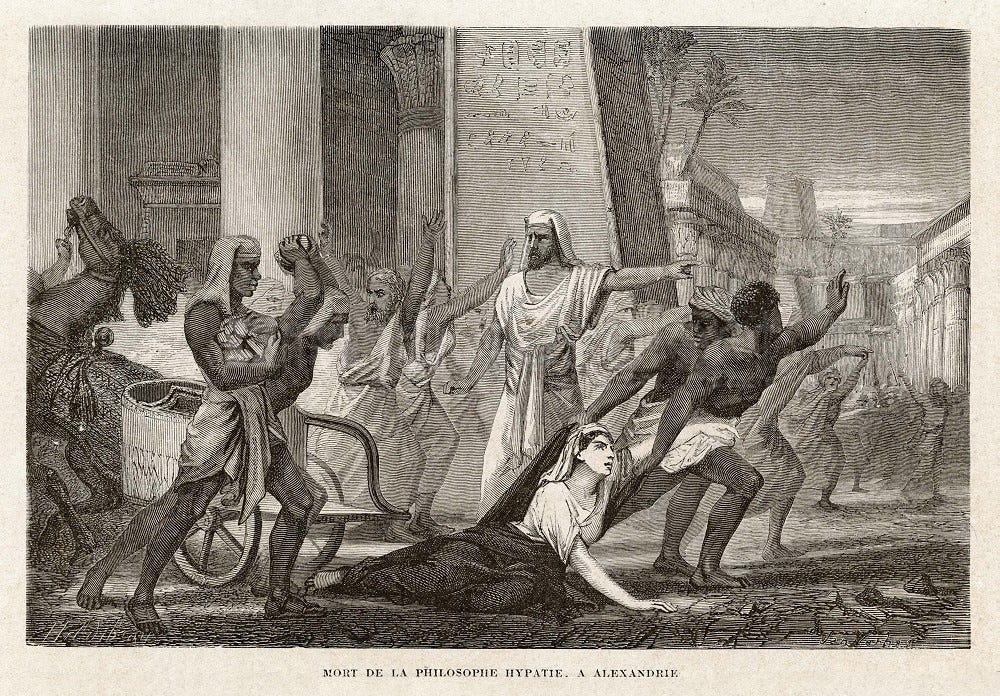
As March is Women’s History Month, I promised you in my last stack that I would dedicate it to some influential women in history whose work and overall stance remain exemplary today, reminding us why, centuries later, they deserve to be remembered.
Some of them, like Saint Philothei of Athens, are relatively unknown. Others, however, like Hypatia whom we will examine today, are famous—partly due to the importance and timelessness of their work (in this case, in the sciences), but also because Hypatia’s cinematic life specifically provided the perfect script for Hollywood, inspiring films like Alejandro Amenábar’s Agora (2009), starring Rachel Weisz.
For the general public, the figure of Hypatia became synonymous with the film, which, although an excellent artistic creation, falls into a historical oversimplification: it presents Hypatia as the victim of a one-dimensional religious conflict.
But was that really the case?
From Diocletian to Theodosius II: The Necessary Historical Context
To understand the socio-political landscape of the time, we must look back at the Roman Empire’s path toward Christianization. Hypatia was born in 370 AD in a violently changing world. Sixty-seven years earlier, on February 23, 303, during the festival of the Terminalia, the Emperor Diocletian had issued an edict of persecution against Christians. But within a few decades, the persecuted would become the persecutors, and the intellectual haven of Alexandria would be torn apart by a ruthless struggle for power. To understand why Hypatia had to die, we have to look past the religious veil and expose the brutal socio-political reality.
Unlock the final chapters:
The Life and Death of Hypatia: A woman at the top of a male-dominated pyramid.
Visiting the Sources: What contemporary to Hypatia sources, historians, and her own students reveal about her life and the true circumstances of her death: Synesius of Cyrene, Socrates Scholasticus and Suda Lexicon.
The Forge of Byzantium: A new, Christian, Hellenized empire is being formed.
From Paganism to Christianity: A socio-political, rather than purely religious, transition?
A timeless legacy: The path toward women’s emancipation and scientific truth today. Why Hypatia matters.
(P.S. For my Greek readers, a full translation of the essay is included at the very bottom of the post).
Unearthing the true, unfiltered history of the transition from Paganism to Christianity—and figures like Hypatia—takes more than a quick online search. It requires many hours of meticulous research while I balance fatherhood, my work shifts, and my studies in archaeology and art history. If you value this kind of authentic, deep-dive history and want to support the effort behind it, upgrading to a paid subscription makes all the difference. Join our community to unlock the final, gripping chapters of Hypatia’s story.
Here’s 10% off to keep reading behind the paywall. (Further discounts apply for yearly subscriptions):
Whether it’s the price of a single coffee or a book, every contribution matters. Your support helps cover the research and resources needed to keep bringing history and archaeology to life—and goes directly toward funding my MA in Humanities. Thank you for making this work possible:

