


“History worth reading. Stories worth remembering.”
Today, we are traveling back to 16th-century Ottoman Athens. We will learn about a woman who was born into aristocracy and could have lived a life of quiet luxury and submission. Instead, she defied Ottoman pashas, fought the local elite, and built a sanctuary for abused and enslaved women.
Born Rigoula Benizelos, she was ultimately tortured to death for her defiance, only to be remembered by history as Saint Philothei.
Women like her are exactly why, on the 8th of March, we celebrate International Women’s Day, honoring the historical struggles of women for equal rights, suffrage, workplace equality, and freedom. From Aristophanes’ comedy “Lysistrata,” in which the women of Athens declare a sex strike and occupy the Acropolis to force the men to end the Peloponnesian War; to the Alexandrian mathematician, astronomer, and Neoplatonic philosopher Hypatia; from the first female historian, the Byzantine princess Anna Komnene, and the Athenian Saint Philothei, to the first female admiral in modern history, Laskarina Bouboulina, and the strikes of female factory workers in New York in 1857 up to the present day, this date remains an important reminder of the fight against violence, discriminations and the gender pay gap.
To mark the occasion, I’ve chosen to highlight one of these remarkable women. I first encountered her story a few months ago while studying the Benizelos Mansion—the oldest house in Athens—as part of my course on Ottoman-era architecture. Since March is Women’s History Month, I plan to spend the coming weeks showcasing the lives of influential women to remind us why these celebrations still matter,, as even today, gender equality remains a goal rather than a given.
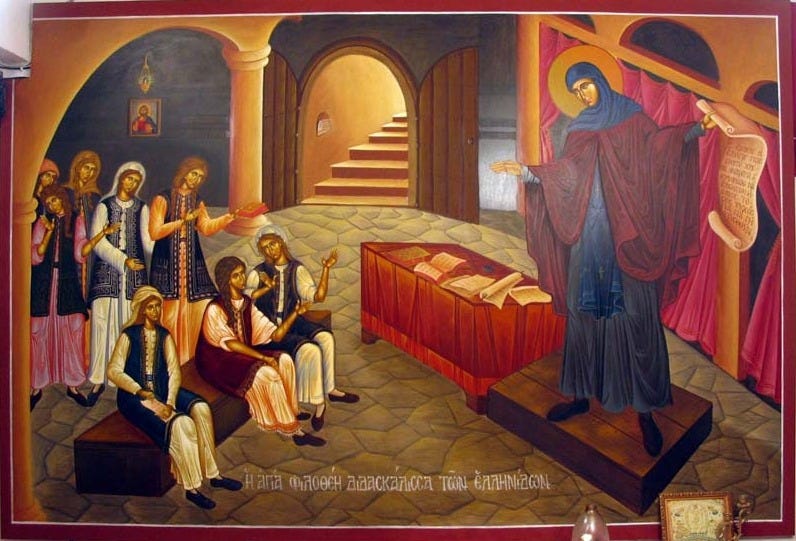
Saint Philothei of Athens (1522–1589) is one of the aforementioned women who stands out as an iconic figure. From a feminist perspective, she represents self-determination, female solidarity, and social subversion. Through her actions, Philothei did not confine herself to traditional religious duties; rather, she acted as a pioneering social activist who used her wealth to elevate the status of women, displaying a free spirit that refused to be trapped by the restrictions of her gender or the subjugated society she lived in, only to be tortured to death.
Before we delve into the details of her life, it is worth saying a few words about the historical context in which Saint Philothei lived, as this will make her actions and their significance much easier to understand.
Desecrating the dying body of the Byzantine Empire
Interestingly, the Ottomans did not conquer Athens from the Byzantines. From 1204 to 1456, Athens was under Frankish rule (Frankokratia) as the Duchy of Athens: After the Fourth Crusade, the de la Roche family (French, 1205–1308) became the first dukes, followed by the Brienne family (1308), the Catalan mercenaries (1311–1388) whose rule was notoriously oppressive, briefly the Navarrese Company (1390), and finally the Acciaiuoli (Italians from Florence, 1395–1456)—the family that lost the city to Omer Bey, Mehmed’s general, in 1456, a precursor to the Ottoman capture of the Acropolis fortress in 1458.
In late 1204, Boniface of Montferrat, military leader of the 4th Crusade, after sacking Constantiople and losing the title of Latin Emperor to Baldwin of Flanders, founded the Kingdom of Thessalonica and marched into southern Greece. He captured Athens, and the Franks proceeded to sack the city. The Church of Panagia Atheniotissa (the Virgin of Athens) inside the Parthenon was pillaged, and the metropolitan library with its precious manuscripts—curated by the Byzantine scholar and Metropolitan Michael Choniates—was completely destroyed.
Behind the paywall:
Athens of Knights and Sultans: The time when “French was better spoken in Greece than in France”!
The Benizelos Mansion: Athens’ oldest house and Saint Philothei’s ancestral home.
Philanthropy and resistance: How Saint Philothei’s work infuriated both Ottoman authorities and the local elite.
Martyrdom and a timeless legacy of emancipation: Why Saint Philothei is still relevant.
And finally: The dismissal hymn (apolytikion) dedicated to her—a hauntingly beautiful post-byzantine chant that will immerse you in a world of otherworldly serenity and profound devotion.
Unearthing the true, unfiltered history of Ottoman Athens and figures like Saint Philothei takes more than a quick online search. It requires many hours of meticulous research and on-site study—like that on the Benizelos Mansion—while I balance fatherhood, my work shifts, and my studies in archaeology. If you value this kind of authentic, deep-dive history and want to support the effort behind it, upgrading to a paid subscription makes all the difference. Join our community to unlock the final, gripping chapters of Saint Philothei's story.
Here's 10% off to keep reading behind the paywall. Further discount for yearly subscriptions:
Whether it’s just the price of a single coffee or a book, every contribution matters. Donations help cover research, writing, and the resources needed to keep sharing my passion for uncovering the past and bringing history, archaeology, and culture to life:
