


“History worth reading. Stories worth remembering.”
On a more personal level, the following text was published twelve years ago in an online literary magazine I was collaborating with at the time. It came to mind these past few days following the publication of my recent articles on Saint Philothei, the art related to Holy Week, and the differences between the Western and Eastern Churches. I also thought of it because of a series of Notes on the exact same subject, which prompted some people (mostly on other social media) to comment that I focus too much on religion—and specifically, on Christianity.
Aside from the fact that they conveniently overlooked my recent piece on Hypatia and the way she was murdered, they also overlook the historical reality that the Christian Church, from the 5th century onwards, replaced the administrative structures in the territories of the collapsing Roman Empire. Not only did it contribute to the survival of the social fabric, but it also enabled the social mobility and visibility of groups that had been marginalized for hundreds of years—a point we analyzed in the Hypatia essay.
Finally, sparked by my latest essay on the 14 paintings related to Holy Week, some people also overlook the fact that art, as we know it today, evolved from and through religious art. The Byzantine iconographers and mosaicists, as well as the Italian masters of the Renaissance, were commissioned by the Church. How we got from them to the abstract art of Kandinsky and Mondrian, the cubism of Picasso and Braque, and the banana duct-taped to Cattelan’s wall, is another, highly fascinating story.
Thus, by studying the evolution of Christianity and Christian art, we are essentially studying the history of Western civilization as we know it today.
And I am not writing all this as a Christian—as you will see below—but as an archaeologist and art historian-to-be—if that counts for anything.
So, here it goes:
I am not sure if God exists or not. How could I be, anyway?
I have never met Him. I have never touched Him. I have never looked Him in the eye.
I have never spoken to Him.
Nor am I sure if the Church truly represents Him.
Actually, I am certain that the way the Church is structured today, there is very little chance it represents God, if He exists.
It’s hard to believe such a thing when, at seventeen, the priest turns you away—discreetly, of course—from confession because you tell him you’re in a relationship with a girl.
Or when a priest refuses to bury your friend who killed herself.
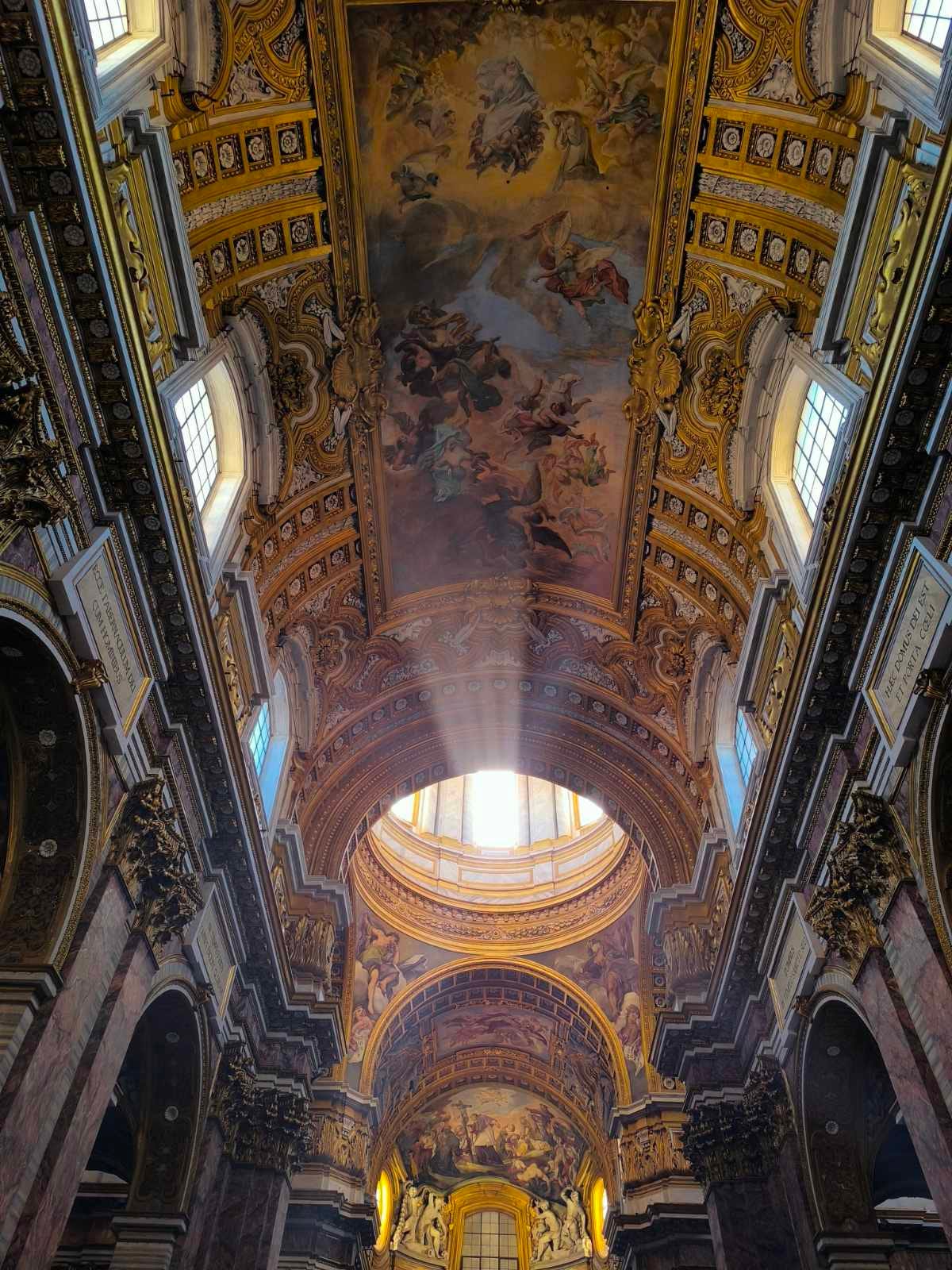
What I do know is that my soul finds peace every time I attend a church service.
Between the incomprehensible chants, the mystical atmosphere, and the intoxicating scent of frankincense and censers, I manage to clear my mind every single time, and I leave feeling lighter and relieved.
A necessary condition, of course, is not being trampled.
Which is hard on days with a massive turnout. But even then, I try.
I try to get into the spirit because, unfortunately, I rarely go to church, and I miss that feeling of religious reverence and devotion.
But this is something entirely personal.
I don’t expect you to understand it, let alone mock you if you aren’t overwhelmed by the same emotions as me every time you find yourself in a church.
Nor do I mock those who are certain (?) about the non-existence of God, considering them, for example, arrogant, haughty, and know-it-alls.
You see, there’s a massive difference that many people—on both sides—pretend not to understand: religious bigotry is one thing, and personal spirituality is another.
Religious bigotry (sanctimony)—that blind, toxic obsession with rules and dogma—is exactly what made that priest turn me away, or refuse to bury my friend. It’s the kind of fanaticism that drains people of their humanity.
On the other hand, what I feel when I walk into a church is a deep sense of spirituality. It’s a calm, personal connection to the mystery, the aesthetics, and the inner peace, without having to sign a contract of blind obedience. I take the reverence, and I leave the intolerance at the door.
And lastly, there is also religiophilia—or threskophilia, if we were to coin the Greek term. It’s that quiet respect for the religious feeling itself. The appreciation for the history, the cultural weight. That deeply human need to believe in something bigger, even if you don’t strictly follow the dogma.
That’s exactly why I get annoyed when some people try to make me feel bad about these deeply personal emotions that overwhelm me in church, especially when those people supposedly champion an ideology of tolerance, equality, respect for diversity, and the freedom to believe whatever one wants.
And if you are among them, and you do it to point out exactly the lack of the aforementioned virtues in the Church—the representative of a non-existent God—guess what: that makes you worse than those you mock and deride.
I may not know if God exists, but sometimes when I pass by a church, crossing myself comes naturally to me–well, it’s a Greek thing.
As a reminder to myself of how small I am before the vastness of the universe.
As a small token of humility.
There, another virtue. You failed the others... Do you have this one?
A Glimpse into the Atmosphere: The Hymns of Good Friday (If you would like to experience the atmosphere I described above, here are two of the most moving Good Friday hymns, performed by two of Greece’s most iconic voices).
1. “O Glyki Mou Ear” (O, My Sweet Spring) – Performed by Glykeria
Glykeria is one of Greece’s most acclaimed and emotionally expressive singers, known for her unique ability to bridge traditional, folk, and Byzantine religious music. O Glyki Mou Ear is a deeply poignant lamentation sung normally during the Good Friday service. It represents the Virgin Mary’s raw, maternal grief as she mourns over the lifeless body of her son, Jesus, calling him her “sweet spring.”
2. “Ai Geneai Pasai” (All the Generations) – Performed by Petros Gaitanos
Petros Gaitanos is a prominent Greek vocalist widely celebrated for his absolute mastery of Byzantine music and Orthodox hymns; his voice is virtually synonymous with the Easter period in Greece. Ai Geneai Pasai is a profoundly moving hymn sung during the procession of the Epitaphios (the symbolic wooden tomb of Christ). Its lyrics express how “all the generations” come together to offer their praise and mourning.
Until the next stack, ἔρρωσθε καὶ εὐδαιμονεῖτε.
So… I did a thing. I applied for an MA in Education and Humanities using my first degree. Thus, whether it’s just the price of a single frappé coffee or a book, every contribution matters. Donations help cover research, writing, and the resources needed to keep sharing my passion for uncovering the past and bringing history, archaeology, and culture to life:
Not sure why I was sent this, but I could really relate to your views on God. My own is similar to yours in that we can't define who God is, yet God pervades so much of history, not just through art and architecture but an influence in the lives of so many who lived it.
I'm exploring the question through writing, in a different way, through fiction. Best wishes to you.
An enjoyable read. As for if God exists, he does exist. I've been a born again Christian ✝️ since age 11. The Trinity in the Bible is made up of God the Son, God the Father, God the Holy Ghost.