


“History worth reading. Stories worth remembering.”
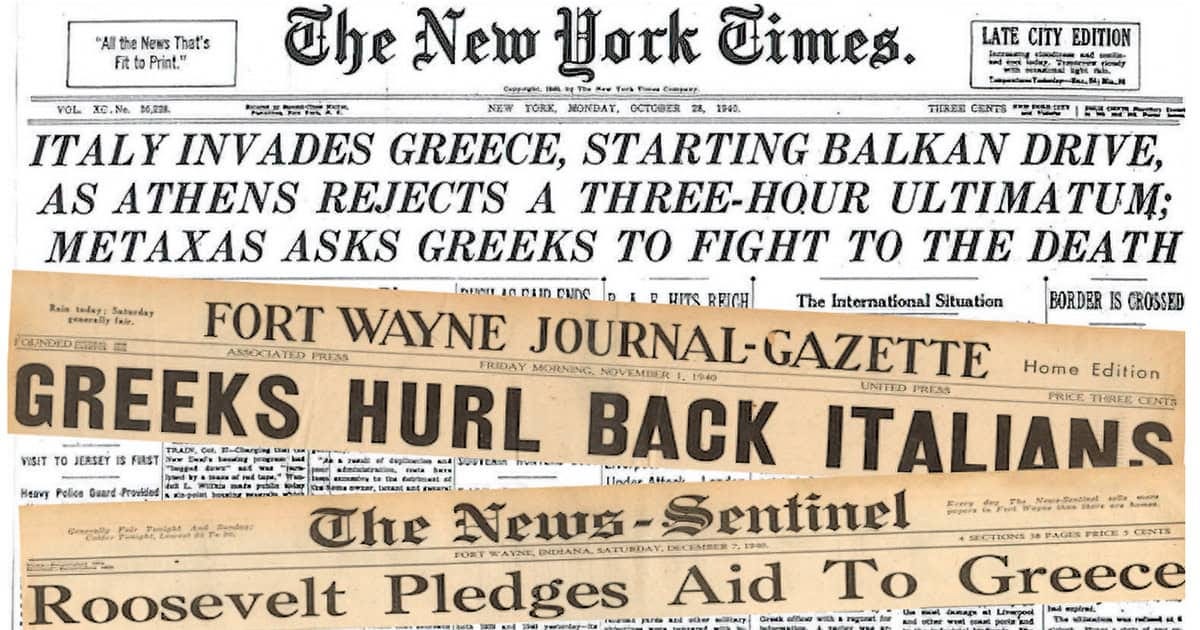
In the early hours of October 28, 1940, the Italian ambassador in Athens, Emanuele Grazzi, delivered an ultimatum to the Greek Prime Minister, Ioannis Metaxas, demanding the free passage of Italian troops to occupy unspecified “strategic points” within the country. Metaxas, already aware of the Italian army’s movements at the border, and while Rome had been engaging in escalating provocations over the preceding months (culminating in the torpedoing of the cruiser Elli on August 15 in Tinos), stoically replied: “Alors, c’est la guerre.” It was the first “No” to the Italians’ ambitions, who would ultimately be pushed back deep into Albania.
(for the original text in Greek, scroll down)
The front remained unbroken until the forced intervention of their German allies in April 1941 to salvage the Axis’ prestige, followed by the entry of the Bulgarians, who occupied and annexed Eastern Macedonia and Thrace.
Greece, as we have mentioned in the past, has the historical originality of commemorating the beginning of two wars with its two national holidays, rather than their end: on March 25th the Revolution of 1821, through which it gained its independence from the Ottomans, and on October 28th—Ohi Day (the Day of the No)—its entry into World War II in 1940, with Metaxas’s refusal to surrender without a fight. The reasons for this is something we have discussed many times in notes and previous articles. A few days ago, an article of mine was published in the Estia newspaper, in which I examine these events, shedding light—even if briefly—on the actions of another protagonist of the era: the Archbishop of Athens, Chrysanthos. Through his stance, and with the help of my beloved C.P. Cavafy, the article illustrates the true and timeless moral weight carried by a “No”.
For now, this article is available for everyone to read. If you’d like unlimited access to the full archive and want to support the work behind this newsletter, consider becoming a paid subscriber.
The following is the English version of the piece published in the Estia newspaper:
He that did make the great refusal
There are moments in a person’s life when their stature is measured not by their height, but by their actions. In one such moment, Thomas More, the illustrious English humanist and former Lord Chancellor, refused to take the oath demanded by his erstwhile friend, King Henry VIII. By refusing to recognize the king as the supreme head of the Church of England, he paid for his defiance with his head in 1535. His life was turned into a play and a film titled A Man for All Seasons. A man, that is, who remains faithful to his values regardless of the prevailing climate.
The “no”s we say in life, therefore, define us, and sometimes we pay the ultimate price for them. While on the dawn of October 28, 1940, Ioannis Metaxas may have replied in French to the Italian ultimatum, “Alors, c’est la guerre” (Well then, it is war), the actual “No” was spoken on his behalf by the Greek people. A few hours later, the Archbishop of Athens, Chrysanthos, bid farewell to those leaving for the front with a proclamation from the Holy Synod, of which he was the president:
“The Church blesses these sacred weapons and is confident that all the children of the Fatherland, obedient to its call and to God’s, will hasten with one soul and heart to fight for their altars and hearths, and for freedom and honor; and they will thus continue the uninterrupted series of honorable and glorious struggles from centuries past, and will prefer a beautiful death to the ugly life of slavery...”
And the children of the fatherland did indeed hasten. Pindos and the Albanian Epic followed—the first victories against the Axis in a yielding Europe. In April 1941, it was the turn of the Metaxas Line fortresses to say “No,” this time to the Germans, who had postponed their eastern campaign to salvage their allies’ honor. But the front collapsed. General Georgios Tsolakoglou signed the capitulation, while the king and the government fled to Crete to fight another day. On April 27, the Germans entered Athens, and the swastika was raised on the Acropolis. The country was now under a triple occupation.
Seeing the Greek flag lowered from the Acropolis from his office window, the Archbishop noted in his diary: “My soul is sorrowful even unto death.” Meanwhile, he had already been asked to participate in the committee that would surrender the city. He refused, stating, as he wrote, that the task of an archbishop is not to enslave, but to liberate. Later, when summoned to officiate a victory service for the conqueror’s entry, he replied that its time would come later, foreshadowing the hour of liberation.
That same afternoon, he was visited by the German General Stumme. The general offered to converse in French, but Chrysanthos preferred German, as he was fluent in the language. Their dialogue is characteristic:
– “You seem tired.”
– “Yes, we found bridges and roads destroyed by the British. Who will repair them? The British must pay.”
– “He who will be defeated shall pay.”
Two days later came another request, the one that would ultimately cost him his archiepiscopal throne: to swear in the government formed by Tsolakoglou with German approval. He commented on the event by saying that the people would fall into “two evils”: the tyranny of the conquerors and the tyranny of the “pseudo-government.” One of the new ministers asked him if he would prefer German Gauleiters to rule the country. He answered “yes,” because they would do less harm. He refused to swear them in, or even to send someone else in his place. On the morning of April 30, the parish priest of Agios Georgios Karytsis finally swore in the collaborationist government.
Not ready to upgrade yet? You can still support the effort behind this newsletter for free by simply tapping the like button or restacking this post. Alternatively, you can always treat me to a frappé coffee:
Who, then, was this man whom the Church of Greece refers to today as “the first resistance fighter”?
Born Charilaos Filippidis in 1881 in Komotini, he studied at the Halki Theological School and later in Leipzig and Lausanne. He taught himself German, read Goethe and Schiller in his twenties, and memorized Palamas. He was friends with Ion Dragoumis and Penelope Delta. Regarding the poet Konstantinos Hatzopoulos, he wrote that the days they spent together in a quiet Bavarian village named Dachau were among the most beautiful of his life. More than twenty years later, the village’s name would become synonymous with the first Nazi concentration camp. The German-speaking scholar who addressed the conqueror in his own language knew well which Germany he had loved and which one he now faced.
In 1913, he was elected Metropolitan of Trebizond. When the Russians approached in 1916 during the First World War, the Turkish governor handed him authority over the city. Chrysanthos cared for all its inhabitants, Christians and Muslims alike. Even though the Russians entered the city as liberators, he refused to hand it over to them himself, sending an ordinary citizen in his place. He later defended the cause of Pontus at the Peace Conference, and the Kemalists sentenced him to death in absentia.
He ascended to the archiepiscopal throne in late 1938 through the intervention of the 4th of August Regime—Metaxas’s dictatorship, which annulled the election of the Venizelist Damaskinos. The collaborationist government would use this fact when the Germans demanded his removal. In the summer of 1941, Damaskinos was reinstated, and Chrysanthos withdrew to a small house in Kypseli. There, on Soumela Street, he lived by selling vestments and books. Some claim he quietly continued his own resistance from there throughout the occupation.
Indeed, when Damaskinos fell out of favor with the Germans in February 1944, and Chrysanthos was summoned to resume his duties, like another “man for all seasons,” he refused once more. He would not, he said, take part in rending the seamless robe of the Lord just to please the enemies of the fatherland.
Damaskinos took a different path, but he too said his own great “No.” In March 1943, when the deportations of the Jews of Thessaloniki began, he gathered the signatures of the most prominent Greeks for an open protest, unique in all of occupied Europe. And he did not stop at words: the churches of the Archdiocese issued baptismal certificates, the police issued fake identity cards, and thousands of Athenian Jews were saved. For his actions then, Yad Vashem honored him as Righteous Among the Nations. History needed both men to “make their own great refusal.”
C.P. Cavafy spoke of this “refusal” in 1899 in a poem with a title borrowed from Dante. In the third canto of the Inferno, the poet sees the shade of him “che fece per viltade il gran rifiuto”—who out of cowardice made the great refusal. Tradition identifies him as Pope Celestine V, who abdicated his throne just months after his election. Cavafy keeps the characteristic line and builds a poem upon it, stripping away the cowardice and leaving an ellipsis in its place. In his poem, the refusal becomes a “no—the right no,” which a person does not regret, even if they pay the price for it. Thus, Cavafy gives the great refusal a different moral dimension: saying no is no longer an evasion, but an active assumption of responsibility.
And so, more than four decades before Chrysanthos’s act of resistance, it is as if a poem was written precisely for him. He, too, was asked again, and again he said no. That “no” burdened him until the end, for he died in 1949 without ever seeing his throne again. Because the right “no” promises no reward. It promises only that you will not have to regret it.
Che fece . . . . il gran rifiuto
For some people the day comes
when they have to declare the great Yes
or the great No. It’s clear at once who has the Yes
ready within him; and saying it,
he goes forward in honor and self-assurance.
He who refuses does not repent. Asked again,
he would still say no. Yet that no—the right no—
undermines him all his life.
C.P. CAVAFY: Collected Poems Revised Edition, translated by Edmund Keeley and Philip Sherrard, edited by George Savidis. Translation copyright © 1975, 1992 by Edmund Keeley and Philip Sherrard. Princeton University Press. | onassis.org
Until the next stack, ἔρρωσθε καὶ εὐδαιμονεῖτε.
If you value authentic deep historic dives and want to support my work in bringing history, archaeology, and culture to life, consider becoming a paid subscriber.
Not ready to upgrade? You can still support the immense effort behind this newsletter for free by simply tapping the like button or restacking this post. Alternatively, you can always treat me to a frappé coffee:
ακολουθεί το κείμενο στα ελληνικά
Che fece . . . . il gran rifiuto: Το ηθικό βάρος ενός Όχι
Τα ξημερώματα της 28ης Οκτωβρίου 1940, ο Ιταλός πρεσβευτής στην Αθήνα, Εμανουέλε Γκράτσι, παρέδωσε ένα τελεσίγραφο στον Έλληνα Πρωθυπουργό Ιωάννη Μεταξά, ζητώντας του την ελεύθερη διέλευση των ιταλικών στρατευμάτων προκειμένου να καταλάβουν μη καθορισμένα «στρατηγικά σημεία» της χώρας. Ο Μεταξάς, ήδη ενήμερος για τις κινήσεις του ιταλικού στρατού στα σύνορα και ενώ τους προηγούμενους μήνες η Ρώμη προέβαινε σε κλιμακούμενες προβοκάτσιες (με αποκορύφωμα τον τορπιλισμό του καταδρομικού «Έλλη» τον Δεκαπενταύγουστο στην Τήνο), απάντησε στωικά: «Alors, c’est la guerre». Ήταν το πρώτο «Όχι» στις ορέξεις των Ιταλών, οι οποίοι τελικά θα απωθούνταν βαθιά μέσα στην Αλβανία. Το μέτωπο έμεινε αρραγές μέχρι την αναγκαστική εμπλοκή των συμμάχων τους Γερμανών τον Απρίλιο του 1941 προκειμένου να διασώσουν το γόητρο του Άξονα, αλλά και την επακόλουθη είσοδο των Βουλγάρων, οι οποίοι κατέλαβαν και προσάρτησαν την Ανατολική Μακεδονία και τη Θράκη.
Η Ελλάδα, όπως έχουμε πει στο παρελθόν, έχει την ιστορική πρωτοτυπία να τιμά με τις δύο εθνικές της γιορτές την έναρξη δύο πολέμων, αντί για τη λήξη τους: την 25η Μαρτίου την Επανάσταση του 1821, με την οποία κέρδισε την ανεξαρτησία της από τους Οθωμανούς, και την 28η Οκτωβρίου —τη Μέρα του Όχι— την είσοδό της στον Β’ Παγκόσμιο Πόλεμο το 1940, με την άρνηση του Μεταξά να παραδοθεί αμαχητί. Το γιατί συμβαίνει αυτό το έχουμε συζητήσει πολλές φορές σε notes και προηγούμενα άρθρα. Πριν από λίγες ημέρες, δημοσιεύθηκε ένα άρθρο μου στην εφημερίδα «Εστία», στο οποίο εξετάζω τα παραπάνω, φωτίζοντας —έστω και εν συντομία— τη δράση ενός άλλου πρωταγωνιστή της εποχής: του Αρχιεπισκόπου Αθηνών Χρύσανθου. Μέσα από τη δική του στάση, και με τη βοήθεια του αγαπημένου μου Κ.Π. Καβάφη, περιγράφεται το πραγματικό και διαχρονικό ηθικό βάρος που φέρει ένα «Όχι».
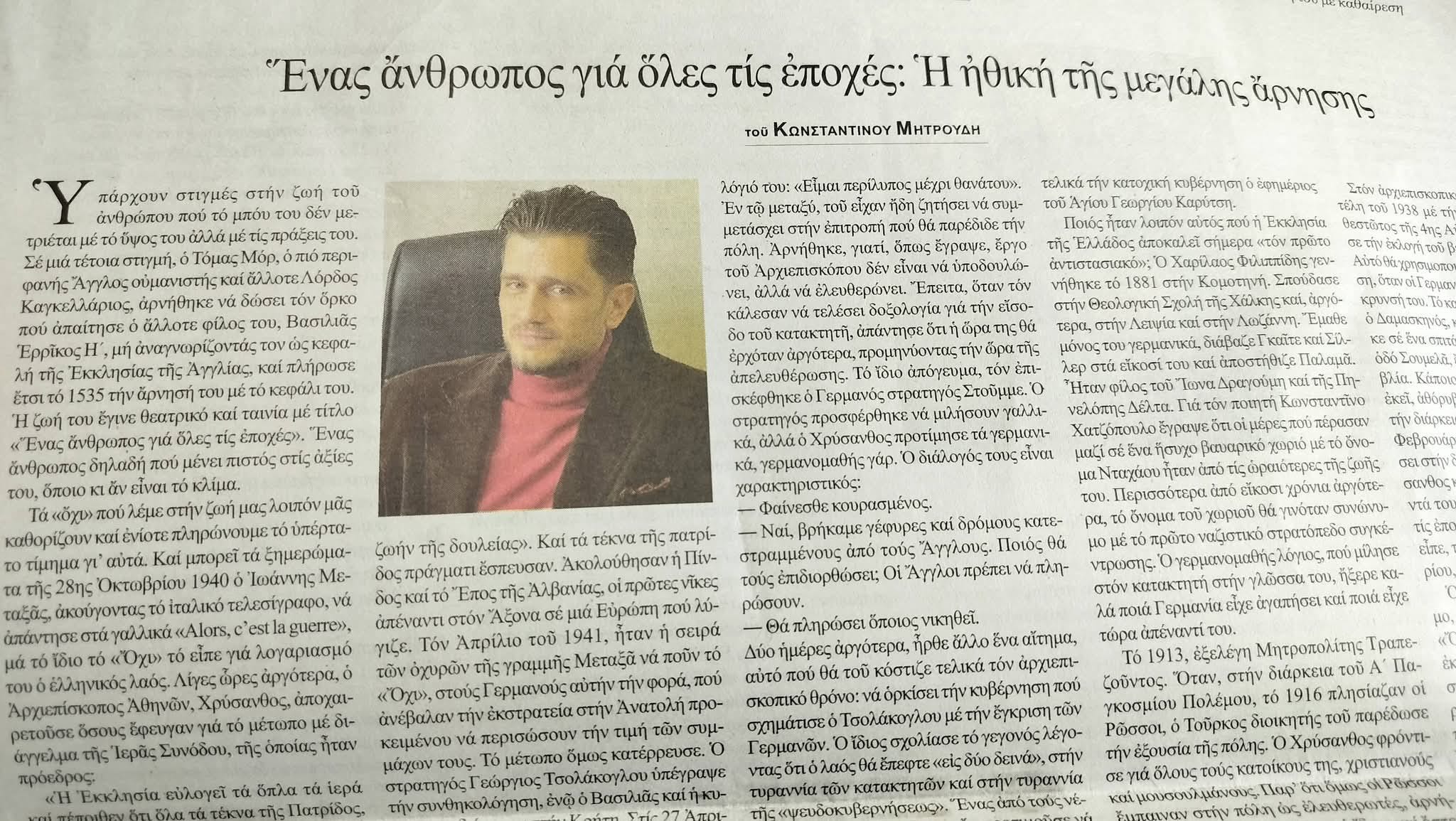
Υπάρχουν στιγμές στη ζωή του ανθρώπου που το μπόι του δεν μετριέται με το ύψος του αλλά με τις πράξεις του. Σε μια τέτοια στιγμή, ο Τόμας Μορ, ο πιο περιφανής άγγλος ουμανιστής και άλλοτε Λόρδος Καγκελάριος, αρνήθηκε να δώσει τον όρκο που απαίτησε ο άλλοτε φίλος του βασιλιάς Ερρίκος Η΄, μη αναγνωρίζοντάς τον ως κεφαλή της εκκλησίας της Αγγλίας και πλήρωσε έτσι το 1535 την άρνησή του με το κεφάλι του. Η ζωή του έγινε θεατρικό και ταινία με τίτλο «Ένας άνθρωπος για όλες τις εποχές». Ένας άνθρωπος, δηλαδή, που μένει πιστός στις αξίες του όποιο κι αν είναι το κλίμα.
Τα όχι που λέμε στη ζωή μας, λοιπόν, μας καθορίζουν και ενίοτε πληρώνουμε το υπέρτατο τίμημα γι’ αυτά. Και μπορεί τα ξημερώματα της 28ης Οκτωβρίου 1940 ο Ιωάννης Μεταξάς ακούγοντας το ιταλικό τελεσίγραφο να απάντησε στα γαλλικά: «Alors, c’est la guerre», μα το ίδιο το Όχι το είπε για λογαριασμό του ο ελληνικός λαός. Λίγες ώρες αργότερα ο Αρχιεπίσκοπος Αθηνών Χρύσανθος αποχαιρετούσε όσους έφευγαν για το μέτωπο με διάγγελμα της Ιεράς Συνόδου, της οποίας ήταν πρόεδρος:
«Η Εκκλησία ευλογεί τα όπλα τα ιερά και πέποιθεν ότι όλα τα τέκνα της Πατρίδος, ευπειθή εις το κέλευσμα αυτής και του Θεού, θα σπεύσωσιν εν μια ψυχή και καρδία να αγωνισθώσιν υπέρ βωμών και εστιών και της ελευθερίας και της τιμής και θα συνεχίσωσιν ούτως την απ’ αιώνων πολλών αδιάκοπον σειράν των τιμίων και ενδόξων αγώνων και θα προτιμήσωσι τον ωραίον θάνατον από την άσχημον ζωήν της δουλείας…»
Και τα τέκνα της πατρίδος πράγματι έσπευσαν. Ακολούθησαν η Πίνδος και το Έπος της Αλβανίας, οι πρώτες νίκες απέναντι στον Άξονα σε μια Ευρώπη που λύγιζε. Τον Απρίλιο του 1941 ήταν η σειρά των οχυρών της γραμμής Μεταξά να πουν το Όχι, στους Γερμανούς αυτή τη φορά που ανέβαλαν την εκστρατεία στην ανατολή προκειμένου να περισώσουν την τιμή των συμμάχων τους. Το μέτωπο όμως κατέρρευσε. Ο στρατηγός Γεώργιος Τσολάκογλου υπέγραψε τη συνθηκολόγηση, ενώ ο βασιλιάς και η κυβέρνηση διέφυγαν στην Κρήτη. Στις 27 Απριλίου οι Γερμανοί μπήκαν στην Αθήνα και η σβάστικα υψώθηκε στην Ακρόπολη. Η χώρα βρισκόταν πια υπό τριπλή κατοχή.
Αντικρίζοντας ο Αρχιεπίσκοπος από το γραφείο του την υποστολή της ελληνικής σημαίας στην Ακρόπολη, σημείωσε στο ημερολόγιό του: «Είμαι περίλυπος μέχρι θανάτου». Εν τω μεταξύ του είχαν ήδη ζητήσει να συμμετάσχει στην επιτροπή που θα παρέδιδε την πόλη. Αρνήθηκε, γιατί, όπως έγραψε, έργο του αρχιεπισκόπου δεν είναι να υποδουλώνει αλλά να ελευθερώνει. Έπειτα, όταν τον κάλεσαν να τελέσει δοξολογία για την είσοδο του κατακτητή, απάντησε ότι η ώρα της θα ερχόταν αργότερα, προμηνύοντας την ώρα της απελευθέρωσης.
Το ίδιο απόγευμα τον επισκέφθηκε ο Γερμανός στρατηγός Στούμε. Ο στρατηγός προσφέρθηκε να μιλήσουν γαλλικά, αλλά ο Χρύσανθος προτίμησε τα γερμανικά, γερμανομαθής γαρ. Ο διάλογός τους, είναι χαρακτηριστικός:
– Φαίνεσθε κουρασμένος.
– Ναι, βρήκαμε γέφυρες και δρόμους κατεστραμμένους από τους Άγγλους. Ποιος θα τους επιδιορθώσει; Οι Άγγλοι πρέπει να πληρώσουν.
– Θα πληρώσει όποιος νικηθεί.
Δύο ημέρες αργότερα ήρθε άλλο ένα αίτημα, αυτό που θα του κόστιζε τελικά τον αρχιεπισκοπικό θρόνο: να ορκίσει την κυβέρνηση που σχημάτισε ο Τσολάκογλου με την έγκριση των Γερμανών. Ο ίδιος σχολίασε το γεγονός λέγοντας ότι ο λαός θα έπεφτε «εις δύο δεινά», στην τυραννία των κατακτητών και στην τυραννία της «ψευδοκυβερνήσεως». Ένας από τους νέους υπουργούς τον ρώτησε αν προτιμούσε να κυβερνήσουν τη χώρα Γερμανοί γκαουλάιτερ. Απάντησε «ναι», γιατί εκείνοι θα έκαναν μικρότερο κακό. Αρνήθηκε να τους ορκίσει, όπως και να στείλει έστω κάποιον άλλον στη θέση του. Το πρωί της 30ής Απριλίου όρκισε τελικά την κατοχική κυβέρνηση ο εφημέριος του Αγίου Γεωργίου Καρύτση.
Ποιος ήταν λοιπόν αυτός που η Εκκλησία της Ελλάδος αποκαλεί σήμερα «τον πρώτο αντιστασιακό»;
Ο Χαρίλαος Φιλιππίδης γεννήθηκε το 1881 στην Κομοτηνή. Σπούδασε στη Θεολογική Σχολή της Χάλκης και αργότερα στη Λειψία και στη Λωζάνη. Έμαθε μόνος του γερμανικά, διάβαζε Γκαίτε και Σίλερ στα είκοσί του και αποστήθιζε Παλαμά. Ήταν φίλος του Ίωνα Δραγούμη και της Πηνελόπης Δέλτα. Για τον ποιητή Κωνσταντίνο Χατζόπουλο έγραψε ότι οι μέρες που πέρασαν μαζί σε ένα ήσυχο βαυαρικό χωριό με το όνομα Νταχάου ήταν από τις ωραιότερες της ζωής του. Περισσότερα από είκοσι χρόνια αργότερα, το όνομα του χωριού θα γινόταν συνώνυμο με το πρώτο ναζιστικό στρατόπεδο συγκέντρωσης. Ο γερμανομαθής λόγιος που μίλησε στον κατακτητή στη γλώσσα του, ήξερε καλά ποια Γερμανία είχε αγαπήσει και ποια είχε τώρα απέναντί του.
Το 1913 εξελέγη Μητροπολίτης Τραπεζούντος. Όταν, στη διάρκεια του Α΄ Παγκοσμίου Πολέμου, το 1916 πλησίαζαν οι Ρώσοι, ο Τούρκος διοικητής τού παρέδωσε την εξουσία της πόλης. Ο Χρύσανθος φρόντισε για όλους τους κατοίκους της, χριστιανούς και μουσουλμάνους. Παρότι όμως οι Ρώσοι έμπαιναν στην πόλη ως ελευθερωτές, αρνήθηκε να τους την παραδώσει ο ίδιος, και έστειλε στην θέση του έναν απλό πολίτη. Αργότερα υπερασπίστηκε την υπόθεση του Πόντου στη Συνδιάσκεψη της Ειρήνης, και οι κεμαλικοί τον καταδίκασαν ερήμην σε θάνατο.
Στον αρχιεπισκοπικό θρόνο ανέβηκε στα τέλη του 1938 με την παρέμβαση του καθεστώτος της 4ης Αυγούστου, που ακύρωσε την εκλογή του βενιζελικού Δαμασκηνού. Αυτό θα χρησιμοποιούσε η κατοχική κυβέρνηση όταν οι Γερμανοί θα ζητούσαν την απομάκρυνσή του. Το καλοκαίρι του 1941 επανήλθε ο Δαμασκηνός, και ο Χρύσανθος αποσύρθηκε σε ένα σπιτάκι στην Κυψέλη. Εκεί, στην οδό Σουμελά, έζησε πουλώντας άμφια και βιβλία. Κάποιοι τον θέλουν να συνεχίζει από εκεί, αθόρυβα, τη δική του αντίσταση κατά τη διάρκεια της κατοχής.
Μάλιστα, όταν τον Φεβρουάριο του 1944 ο Δαμασκηνός είχε πέσει στη δυσμένεια των Γερμανών, και ο Χρύσανθος κλήθηκε να αναλάβει ξανά τα καθήκοντά του, σαν ένας άλλος «άνθρωπος για όλες τις εποχές», αρνήθηκε ξανά. Δεν θα συνέχιζε, είπε, το σχίσιμο του άρραφου χιτώνα του Κυρίου για να τέρπονται οι εχθροί της πατρίδας.
Ο Δαμασκηνός ακολούθησε άλλον δρόμο, αλλά είπε κι εκείνος το δικό του μεγάλο Όχι. Τον Μάρτιο του 1943, όταν άρχισαν οι εκτοπισμοί των Εβραίων της Θεσσαλονίκης, συγκέντρωσε τις υπογραφές των επιφανέστερων Ελλήνων κάτω από μια ανοιχτή διαμαρτυρία, μοναδική σε ολόκληρη την κατεχόμενη Ευρώπη. Και δεν έμεινε στα λόγια: οι ναοί της Αρχιεπισκοπής εξέδιδαν πιστοποιητικά βάπτισης, η Αστυνομία πλαστές ταυτότητες, και χιλιάδες Εβραίοι της Αθήνας σώθηκαν. Για όσα έπραξε τότε το Γιαντ Βασέμ τον τίμησε ως Δίκαιο των Εθνών. Η Ιστορία χρειάστηκε και τους δύο για να «κάνουν τη δική τους μεγάλη άρνηση».
Γι’ αυτή την «άρνηση» μίλησε το 1899 ο Καβάφης στο ποίημα με τίτλο δανεισμένο από τον Δάντη. Στο τρίτο άσμα της «Κόλασης» ο ποιητής βλέπει τη σκιά εκείνου «che fece per viltade il gran rifiuto», που από δειλία έκανε τη μεγάλη άρνηση. Η παράδοση τον ταυτίζει με τον Πάπα Σελεστίνο Ε΄, που παραιτήθηκε από τον θρόνο του λίγους μήνες μετά την εκλογή του. Ο Καβάφης κρατά τον χαρακτηριστικό στίχο, και χτίζει πάνω του ένα ποίημα αφαιρώντας τη δειλία κι αφήνοντας στη θέση της μια σιωπή από τελείες. Στο δικό του ποίημα η άρνηση γίνεται ένα «όχι —το σωστό—», που ο άνθρωπος δεν το μετανιώνει, κι ας το πληρώνει. Ο Καβάφης, έτσι, δίνει στη μεγάλη άρνηση μία άλλη ηθική διάσταση: το όχι δεν είναι πια υπεκφυγή αλλά ενεργή ανάληψη ευθύνης.
Και κάπως έτσι, περισσότερες από τέσσερις δεκαετίες πριν την πράξη αντίστασης του Χρύσανθου, λες και γράφτηκε ένα ποίημα ακριβώς γι’ αυτόν. Κι αυτός, ρωτήθηκε πάλι, και πάλι όχι ξαναείπε. Εκείνο το όχι τον βάραινε ως το τέλος, γιατί πέθανε το 1949 χωρίς να ξαναδεί τον θρόνο του. Γιατί το σωστό όχι δεν υπόσχεται ανταμοιβή. Υπόσχεται μόνο ότι δεν θα χρειαστεί να το μετανιώσεις.
Che fece . . . . il gran rifiuto
Σε μερικούς ανθρώπους έρχεται μια μέρα
που πρέπει το μεγάλο Ναι ή το μεγάλο το Όχι
να πούνε. Φανερώνεται αμέσως όποιος τόχει
έτοιμο μέσα του το Ναι, και λέγοντάς το πέρα
πηγαίνει στην τιμή και στην πεποίθησί του.
Ο αρνηθείς δεν μετανοιώνει. Aν ρωτιούνταν πάλι,
όχι θα ξαναέλεγε. Κι όμως τον καταβάλλει
εκείνο τ’ όχι — το σωστό — εις όλην την ζωή του.
Μέχρι την επόμενη φορά, ἔρρωσθε καὶ εὐδαιμονεῖτε.
28th Oct has two meanings for me,
It's the day l joined the army which we mark and celebrate as our birthday and l also mark it with Greek friends with Oxi day.
A good day all round.
Ζητώ η Ελλάς!