


“History worth reading. Stories worth remembering.”
This summer, the United States, Canada, and Mexico have turned into a vast, living mosaic of traveling fans, striking colors, and shared experiences due to the World Cup. Since many of you seemed to have enjoyed my Notes on the “Philosophers’ Football Match,” as well as on the Korean fans in Mexico and the unexpected historical link between Korea and Mexico, I thought I would spend some time on football from a historical perspective.
(θα βρείτε το κείμενο στα ελληνικά, στο τέλος του κειμένου)

Although personally I tend to enjoy a basketball game more, it is impossible to ignore the enormous cultural impact of football. Beyond the goals and dramatic moments on the pitch, such as yesterday’s elimination of Germany by Paraguay and Brazil’s narrow escape against Japan, the competition continues to offer moments of genuine beauty, encouraging cultural exchange and mutual understanding. Just a few days ago, a telling example took place in Los Angeles. The Iranian national team, after their final match in the tournament, left a heartfelt note of thanks in the locker room, expressing their gratitude to the host city and its fans:
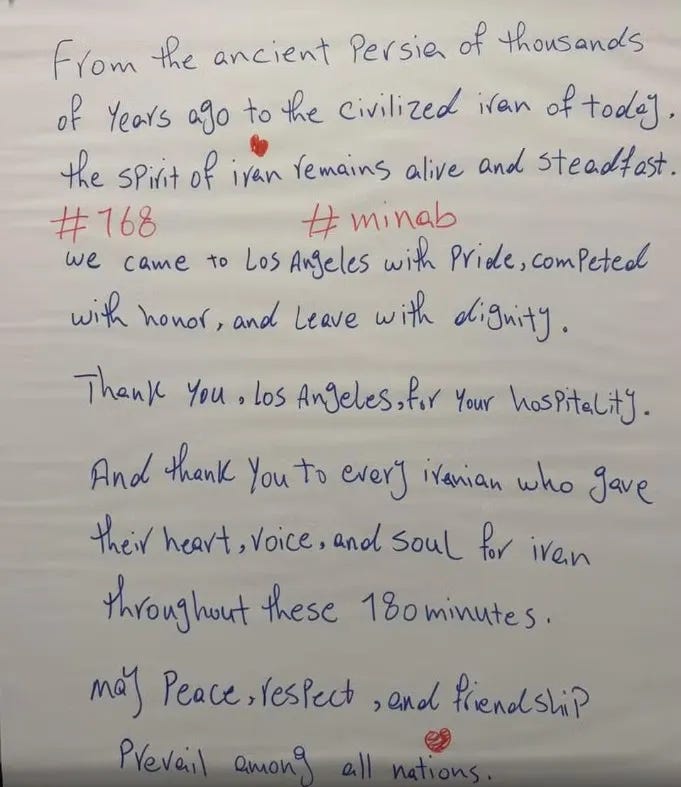
Even more notable was the fact that the Iran’s team captain publicly took a courageous stand in support of the LGBTQ+ community, prompted by a FIFA banner inside the stadium, despite objections from both countries, where homosexuality is criminalized. It was a gesture that moved beyond borders and political considerations, showing once again that sport can serve as a powerful platform for solidarity and peace.
The highly organized form of football we see today—al those referees, VAR, dozens of cameras, and billions in advertising revenue—has its roots in the muddy fields of Victorian England. People had been enthusiastically kicking various objects for millennia, but it was the founding of the Football Association in London in 1863 that finally gave the sport its standardized rules. This decisive moment separated football from rugby and established the laws of the game. From those English fields, the sport spread rapidly across the globe, carried by British sailors, merchants, and railway workers. It was, after all, the era of the all powerful British Empire, “the empire on which the sun never set.” By 1930, international interest reached a peak with the first World Cup in Uruguay, firmly establishing football as the most universal phenomenon of modern history.
And yet, the urge to chase a ball across an open field is far older than modern rules. Long before VAR, artificial turf, and lucrative sponsorships, ancient and medieval societies had their own highly structured and often quite brutal versions of the game. These were deeply embedded in the core of each culture and not simple pastimes. They were functioning as sacred rituals, as rigorous military training, or as intense expressions of local pride.
In this essay, we will travel back in time to explore three fascinating predecessors of the modern game:
The Mesoamerican rituals played in vast stone courts, where the outcome could literally be a matter of life and death: The football of Aztecs and Maya.
The ancient Greek and Roman games that laid the tough foundations of team sports.
Calcio Storico Fiorentino: A spectacular and violent Renaissance contest in the heart of Florence, played by nobles and even Popes, dressed in fine silk.
And finally, we will look at why the sport is called “football” in some parts of the world and “soccer” in others. Which one is correct?
