


“History worth reading. Stories worth remembering.”
So what exactly is history?
My dictionary gives a definition (out of many): the knowledge of past events related to the evolution of humanity (or a social group or activity) that are deemed memorable.
Okay, that’s very general and open to many interpretations, you’ll say. Who chooses what to study, with what qualifications, with what criteria to judge something as memorable? The motto of the father of modern historiography, Leopold von Ranke, was “wie es eigentlich gewesen” or “as it actually happened,” promoting the claim for studying history with maximum objectivity, exhaustive use of sources, without the historian expressing their opinion or making unnecessary comments.
How very German one might say.
But Thucydides also, 2,250 years before Ranke, had said that he would present the events of the Peloponnesian War in his Histories “οὐδ’ ὡς ἐμοὶ ἐδόκει, ἀλλ’ οἷς τε αὐτὸς παρῆν καὶ παρὰ τῶν ἄλλων ὅσον δυνατὸν ἀκριβείᾳ περὶ ἑκάστου ἔλεγον,” that is, not “as it seemed to me, but with accuracy from what I myself saw and others told me,” leading some historians to see Thucydides as the archetype of Ranke, due to emphasis on facts without rhetorical exaggeration.

However, as we are in the festive Christmas period and to get to our topic, I decided to deal with a subject that would probably make Ranke smirk ironically: the story behind classic Christmas songs. How they were written, their evolution, and any weird facts about them.
Ok, it’s not the history of the Napoleonic Wars (or is it? — wait for it), but I’LL DO WHAT I WANT, OK? (brushes Ranke off the right shoulder)
So, what’s the first Christmas song that comes to mind?
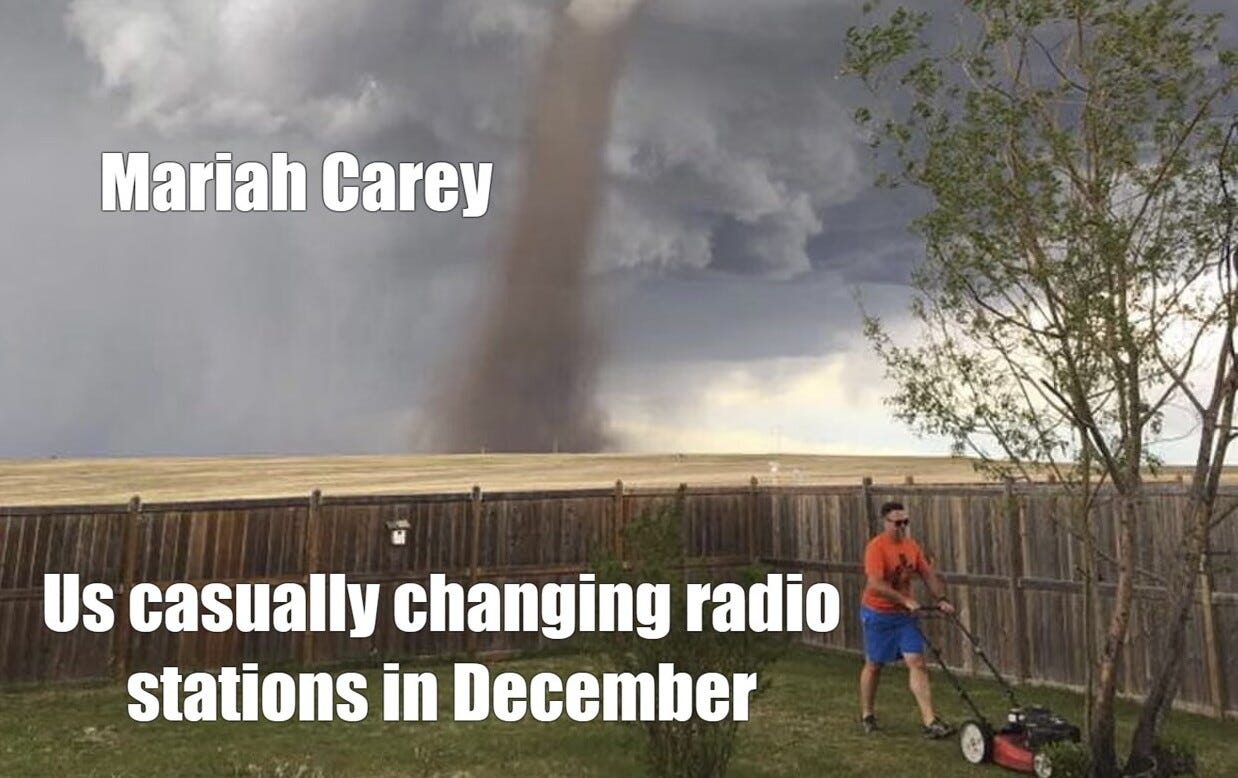
Statistics show it’s probably Mariah Carey’s “All I Want for Christmas Is You,” as it surpasses by far all other Christmas hits annually in airplay and streams charts since its 1994 release. The legend says Carey wrote it in just 15 minutes, inspired by the movie “It’s a Wonderful Life,” but composer and producer Walter Afanasieff has said she started the lyrics alone and he handled the music, instruments, and vocals, in collaboration with her. Carey has said the inspiration for the song and her excessive love for Christmas in general, stem from her wish to escape from a difficult childhood. After overcoming years of disputes where she was accused of stealing the song, she has earned over $100 million from royalties, which doesn’t make the miserable childhood go away, but it’s nice.
And two (kind of) weird facts: In the UK, a bizarre goat-farming experiment found goats produced more milk when hearing the song versus other tunes like Alvin and the Chipmunks songs. And finally, a bar in Dallas once “banned” the song until December, then limited plays to once nightly due to overkill complaints. When the story went viral on Twitter, Carey herself praised their action.
Honoring Ranke, we’ll continue using statistics one more time as our objective guide to move to the second most popular Christmas song in airplays and streams.
How it was written, why it didn’t become No. 1, why it’s NOT really a Christmas song, what Whamageddon (*wink*wink*) is, you’ll see one of the weirdest covers of the song you’ve ever seen, and other interesting and quirky facts about one of the most loved (or not) songs of the holiday season.
Also, I leave Ranke behind and move to personal choices, mine, like Chris Rea’s “Driving Home For Christmas” who just passed away the other day, or my children’s, “All I Want For Christmas Is My Two Front Teeth.” Finally, the story behind the most classic Christmas song of all time (spoiler alert: it’s “Silent Night”), its connection to Napoleonic Wars (eat that, Ranke) and a wonderful a cappella version of a traditional Christmas carol from my place of origin.
Take advantage of a limited-time offer of a 26% discount, valid until New Year’s Day.
Less than €4 a month with the annual plan.
On iPhone? Subscribe on the web at studyinghistory.gr for the lower price.
Not ready to upgrade? A like or restack helps other readers find Studying History. And if you would rather support one essay at a time, you can always treat me to a frappé coffee:
Who you will be supporting:
