


Year 168 BC. Pydna, Macedonia. Perseus, the last king of the Antigonid Macedonian dynasty, watches his famous phalanx being crushed by the Roman legions of Aemilius Paullus. This battle seals the definitive end of the independent Macedonian state. Pydna will forever remain in history as the place where the epilogue of an empire was written. A century and a half earlier, on this exact same soil, another, equally dark epilogue had been written. An epilogue concerning the woman who was the wife of the man who birthed this empire, and the mother of the man who took it to the ends of the earth.
(στο τέλος του κειμένου, θα βρείτε το κείμενο στα ελληνικά)
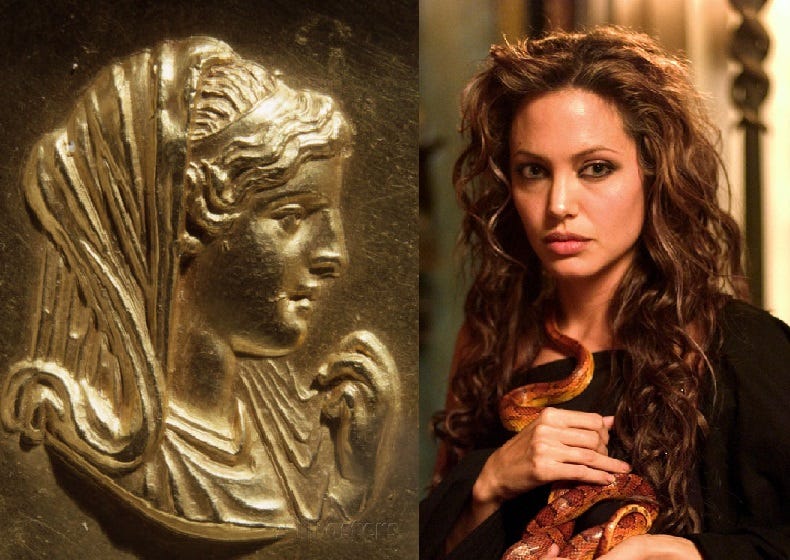
Year 316 BC. Pydna, Macedonia. Since 323 BC and the death of Alexander the Great in Babylon, his generals have engaged in a bloody civil war of succession that will last for decades. Winter has paralyzed everything, and the city on the Aegean coast is slowly dying behind closed gates. Cassander, thirsting for absolute power over the throne in the original core of the Macedonian kingdom in the Greek mainland, has tightened the noose of the siege. Inside Pydna, the situation is described by ancient historians as an absolute nightmare. After seven months of siege, provisions have been exhausted. Soldiers slaughter horses and elephants to feed themselves. When those run out, people resort to eating corpses. In this setting of absolute destitution, Olympias, the woman who gave birth to the man who held the fate of the then-known world in his hands, and to whom many turned after his death to determine the line of succession, is forced to surrender. To persuade her, Cassander had promised her personal safety, without, however, making any promises regarding Alexander’s beautiful Bactrian wife, Roxana, and his son, Alexander IV.
Yet, Cassander broke his promise. Searching for a way to legally get rid of Olympias, and knowing that if he ordered the execution of Alexander the Great’s mother himself, the Macedonian army, which deeply respected her, would likely mutiny, he organized a sham trial. She was condemned in absentia by an assembly influenced by Cassander’s rhetoric and the hatred of her victims’ relatives. And the list of them was quite long. Olympias had previously ordered the slaughter of at least a hundred prominent Macedonian aristocrats, including the murder of Cassander’s brother, Nicanor, as well as the eradication of Alexander’s half-brother, Philip Arrhidaeus, and his ambitious wife, Eurydice.
Olympias, however, was the Queen Mother. She outright rejected Cassander’s offer to flee and demanded what she had been denied: to appear before the Macedonians to stand trial and defend herself publicly. Cassander panicked. He knew the charisma of her voice and the almost religious reverence Alexander’s veterans held for her. He feared that if she spoke, the crowd would change its mind. Therefore, he gave the order to hand her over to the relatives of her victims.
Her sentence was death by stoning. When they surrounded her, she did not step back. She did not beg, she did not cry. She calmly arranged her hair, covered her face with her mantle, and took the stones standing up. She died exactly as she lived. Like a queen who never apologized for her courage and her cruelty.
To understand how she reached this bloody end, we must untangle the thread from the beginning:
