


“History worth reading. Stories worth remembering.”
I’ve mentioned from time to time in my Notes that Ottoman Athens is often overlooked, even though it’s a fascinating chapter of its history. After its Golden Age, Athens was ruled by Hellenistic kings, Romans, Byzantines, Latins, Catalans, and Franks, until 1456—three years after the fall of Constantinople—when it was conquered by Mehmed the Conqueror (the one that conquered Constantinople), who visited in 1458 and granted it special privileges.
During my recent visit to the Roman Agora in Athens, I stopped by the Fethiye Mosque—the mosque of the Conqueror—which, to my pleasant surprise, was not only open but also hosting an intriguing exhibition. It’s titled “In the Footsteps of Apostle Paul” and it is inspired by Paul’s second missionary journey (50–52 AD) through Greece, from Samothrace to Corinth, which led to the creation of the first Christian communities in the world. By tracing the path of the Apostle’s mission and incorporating monuments of global cultural significance, the exhibition seeks to highlight the rich multicultural identity of Athens up until the end of the 6th century AD.
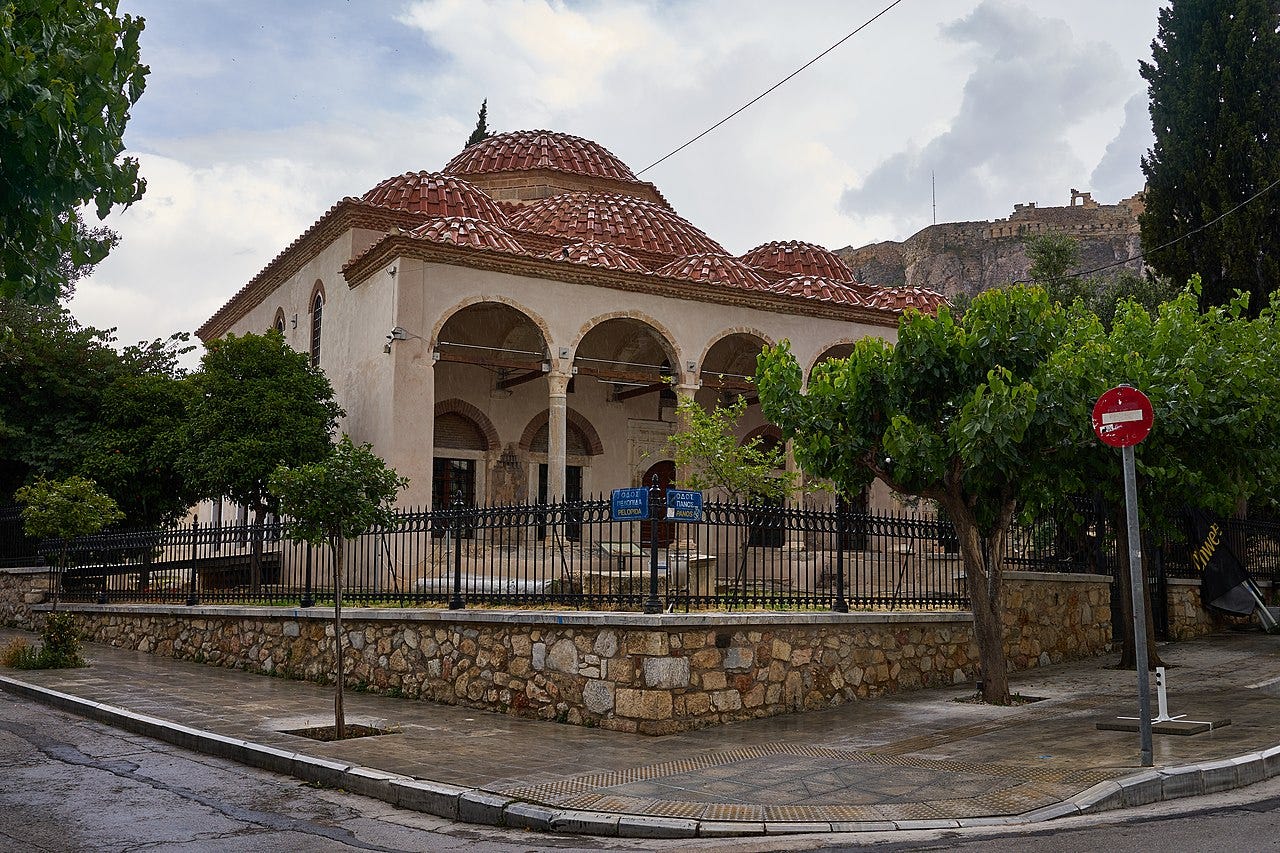
Under this light, the location of the exhibition at the Fethiye Mosque of Athens, which was built on top of a Christian basilica, in the heart of the Roman Agora, symbolizes the timeless coexistence of different cultures and religions within the fabric of the Greek capital.
The Roman World
In the 1st century AD, the Roman Empire of Octavian Augustus and his successors is well established. The emperor is the absolute ruler governing the empire from Rome thanks to the power of his legions and the assistance of the Senate. The empire stretches across the Mediterranean and its nations as well as to the European north, incorporating Germany and Britain. Its subjects mostly speak Latin (in the West) and Greek (in the East), and they can travel and trade without restrictions as long as they pay their taxes. Notably, the New Testament was written in Greek because Koine Greek served as the lingua franca of the eastern Mediterranean during the Hellenistic and Roman periods.
Every city is ruled in the name of the emperor. Citizens often try to gain his favour by erecting his statues, and by holding imperial games. The empire is tolerant of the conquered nations’ various religious beliefs, which gradually begin to mix and form a religious mosaic.
Paul’s Vision of the Man from Macedonia
‘Paul and his companions traveled throughout the region of Phrygia and Galatia, having been kept by the Holy Spirit from preaching the word in the province of Asia. When they came to the border of Mysia, they tried to enter Bithynia, but the Spirit of Jesus would not allow them to. So they passed by Mysia and went down to Troas (the region where Troy was built). During the night Paul had a vision of a man from Macedonia standing and begging him, “Come over to Macedonia and help us.” After Paul had seen the vision, we got ready at once to leave for Macedonia, concluding that God had called us to preach the gospel to them.’
Acts of the Apostles 16:6-10
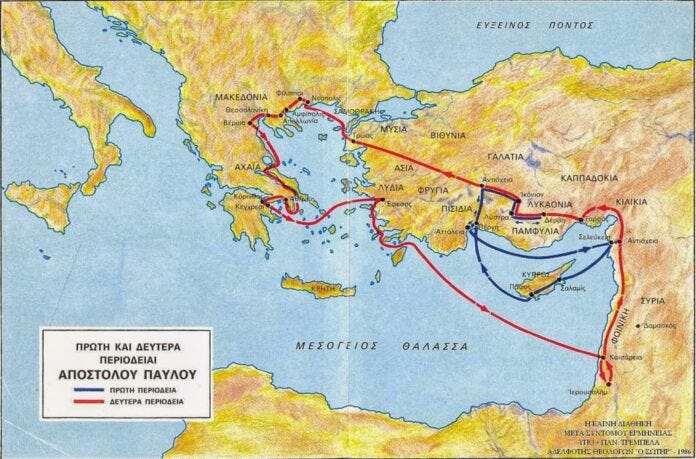
A plea for help in a dream is the starting point of St Paul’s second missionary journey. A journey that starts in Samothrace and ends in Corinth, but which, along the way, will change the course of history and consequently the world. To understand how big of an impact Paul’s life work had, we must first learn about the context in which it took place. Paul spread the teachings of Jesus in the Roman Empire of several nations and gods, and in the communities of the Jewish diaspora, who opposed the new message spread by the Apostle.
In this world, Paul begins his missionary journeys. The second will lead him to Greece, where he first speaks about the Messiah’s advent, the love of God, equality among people and the resurrection of the dead – the ultimate victory of life over death. Saul the persecutor, who lost his sight and found Jesus, now spreads the light of Christianity and becomes His voice in Greece, an important cultural center within he Roman Empire.
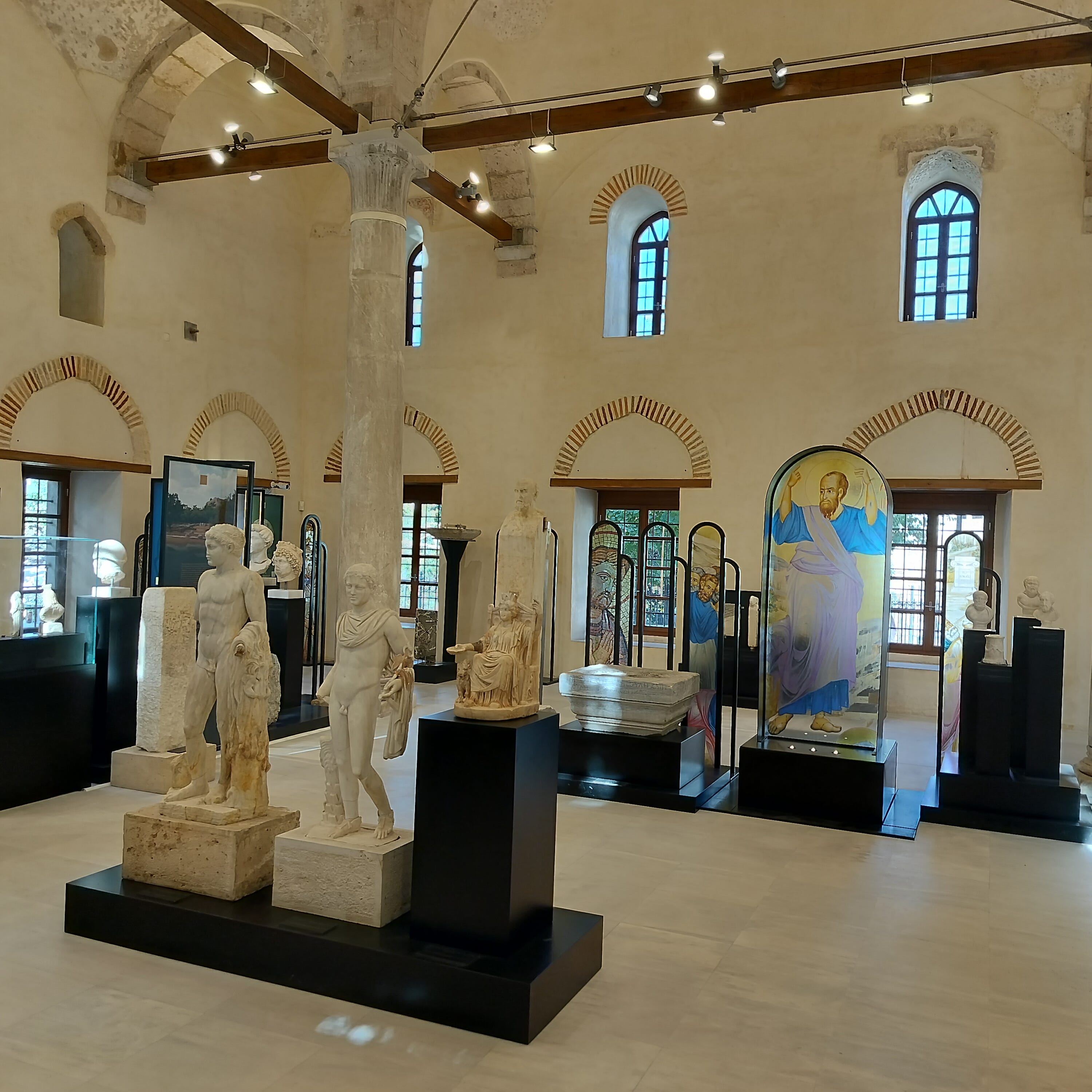
In the exhibition, we follow Paul’s footsteps, his tracks in the cities he passed through, and we listen to the echo of his sermons, on a journey that changed history and led to the beginning of the end of the ancient world.
As we follow in Paul’s footsteps, I’ll toss in some cool historical facts here and there—proof of how fascinating history can become when you see the big picture. Take your time to read the whole stack, as it turned out to be quite long. All photos from the exhibition are mine. As you can see, no-one else was there but me, which is kind of a shame for such a cool — and temporary — exhibition.
Preaching the word of Jesus
“Therefore go and make disciples of all nations…”
Matthew 28:19
Obeying the words of Jesus, Paul makes a total of three journeys in order to spread His message. The Apostle’s first audiences are the Jewish communities of the Diaspora, but soon he realizes that the universality of Jesus’ message resonates also with the Gentiles – the non Jewish people. His first missionary journey begins in AD 46; he is escorted by the Apostle Barnabas. Their first stopover is on the island of Cyprus, followed by the cities of Perge, Antioch of Pisidia, Iconium, Lystra, Derbe and Attalea.
In AD 50, Paul sets off on his second missionary journey from Syrian Antioch, accompanied by Silas, Timothy and Luke. Through Asia Minor, they travel to Samothrace and the Macedonian city of Neapolis, heading for the city of Philippi. The following stops are Amphipolis, Apollonia, Thessalonica, Berea and Athens. Lastly, they visit Corinth, from where Paul sails to Jerusalem in AD 52 .
The third missionary journey begins in AD 53 and ends in AD 57. Among the places visited are Asia Minor, Philippi and Corinth again. Later, he will sail to the eastern Aegean, visiting Mytilene, Oinousses, Samos, Miletus, Kos and Rhodes. In his Epistle to the Romans, Paul contemplates the possibility of a fourth journey to Spain through Rome. On this journey, he expresses his intent to visit Nicopolis, as mentioned in the Epistle to Titus.
Samothrace
“From Troas we put out to sea and sailed straight for Samothrace, and the next day we went on to Neapolis.”
Acts 16:11
Paul arrives on the island of Samothrace in the spring of AD 50. It is the first stopover on his second missionary journey as he sails from the Troad in Asia Minor (the area where ancient Troy was located) to the city of Neapolis (modern Kavala) after dreaming of a man from Macedonia asking for help. Paul will stay on the island just for a day before he departs for Neapolis from the bay at Palaeopolis.
What you will read behind the paywall:
Paul’s most important visits and long-term stays to Philippi (“to Philippians”), Thessaloniki (“to Thessalonians”), Athens (“To the Unknown God”) and Corinth (“to Corinthians”) where he spent almost 2 years.
How his missionary work changed the world.
